How to Pay for Things in China as a Foreign Visitor?
Before you travel to China, it’s worth sorting out how you’ll pay for things during your trip. Payments work differently in China than in many other countries: cash is rarely used, and most people pay using their phone.
For that reason, it’s a good idea to set up mobile payments before you arrive. Once your account and card are set up, paying for everyday things on your trip is usually straightforward.
I live in China, so I’m very familiar with how payments work here. Here are the payment methods you’re most likely to use as a foreign visitor, along with instructions on how to set them up before your trip:
The Best Option for Most Visitors: Mobile Payments
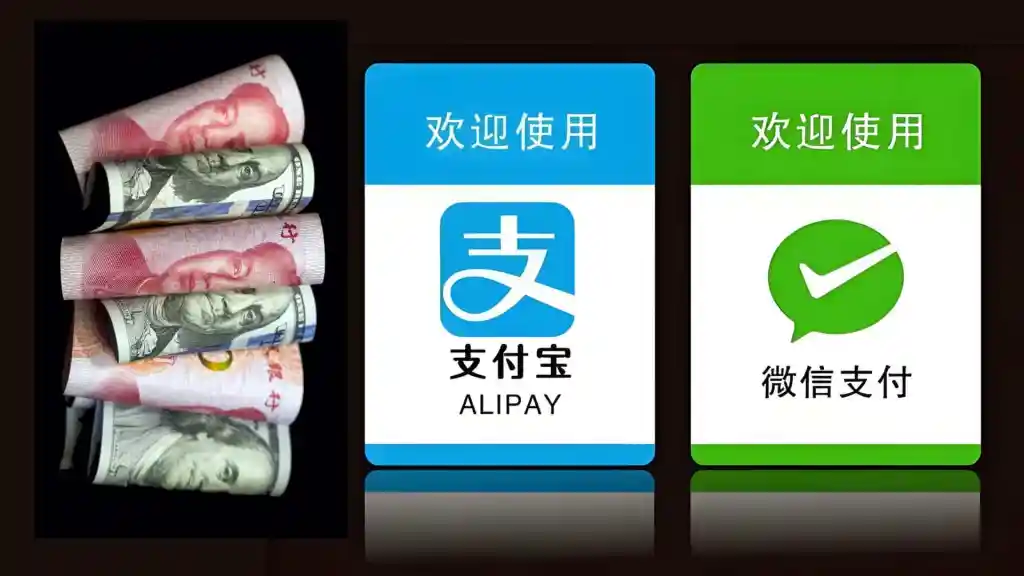
In China, the most common way to pay is by using your cell phone. Start by downloading Alipay or WeChat, creating an account, and linking a bank card.
Once your account is set up, you can use Alipay or WeChat at supermarkets and restaurants, in taxis, and for most other purchases while you’re in China.
Here’s how to set it up:
Both apps are available in English, and signing up is like signing up for other apps. You’ll need a phone number to receive a verification code by text, but it doesn’t have to be a Chinese phone number. Your cell phone number from home will work.
- Complete identity verification.
You’ll need to upload a photo of your passport. Verification takes about a day, so it’s best to do this before you leave.
You can still use Alipay and WeChat without completing identity verification, but some features will be unavailable, like sending money to other users, and your spending limits will be lower.
- Link your credit card.
Add your credit card to the app.
If you travel internationally often, you may also want to consider using a Wise virtual debit card, which may offer a better exchange rate and help reduce some fees.
Important Notes
- The name on your credit card must match the name on your Alipay or WeChat account.
- Alipay and WeChat Pay do not support the same overseas cards. WeChat Pay supports cards such as Visa, Mastercard, JCB, Diners Club, and Discover. Alipay supports Visa, Mastercard, Diners Club, and Discover.
- Set a payment password.
The app will ask you to create a six-digit payment password (essentially a PIN) to confirm payments.
You can also use your fingerprint to confirm payments or enable password-free payments for small purchases.
Read More: A Complete Guide to Using WeChat & WeChat Pay in China
How to Pay with Alipay or WeChat
Alipay and WeChat work similarly to each other. Most visitors only need to know three basic payment methods:
1. Scan the Merchant’s QR Code
This method is common at street-food stalls, small restaurants, and in taxis, where sellers or drivers may not have a separate scanner.
- Open the “Scan” function in Alipay or WeChat
- Scan the merchant’s code
- Enter the amount
- Confirm the payment
Sellers usually provide two QR codes, one for Alipay and one for WeChat. The codes are usually easy to tell apart: Alipay QR codes are blue, while WeChat QR codes are green. Some merchants display a combined QR code showing both logos, which can be scanned with either app.
2. Let the Merchant Scan Your Payment Code
This method is common in supermarkets, convenience stores, hotels, restaurants, and shopping malls.
- The cashier enters the total.
- The cashier scans your payment code.
- Depending on your settings, you may need to confirm the payment. Either way, check the amount to make sure you’re charged the correct total.
3. Pay Through a Mini Program or Other In-App Service
Some purchases aren’t done by scanning a QR code, but instead by paying through a mini program or another service built into Alipay or WeChat. This is often the case when you order food, request a ride, book a hotel room, or buy train or attraction tickets.
- Open the relevant mini program or in-app service.
- Make your selection.
- Review your order.
- Pay directly in the app.
More Than Just Payment Apps
Alipay and WeChat are both “super apps,” because in addition to payments, they include mini programs created by third-party providers. By using these mini programs, you can handle many travel things through Alipay or WeChat without downloading a separate app for each one.
For example, you can use the transit QR codes in either app to pay for bus and subway rides, meaning you can skip the subway ticket machines and avoid carrying small change for buses.
You can also use the apps to book museum visits, request a ride, order food at restaurants, and handle other common travel things.
What Are Mini Programs in WeChat and Alipay?
Mini Programs are basically small, simplified apps that run inside WeChat or Alipay.
They’re created by attractions, restaurants, ride-hailing services, shops, and government agencies. Instead of downloading a separate app for each thing, you can open these Mini Programs right inside WeChat or Alipay, and they don’t take up much space on your phone.
Once your WeChat Pay or Alipay is set up, opening and paying inside Mini Programs is generally quick and easy.
You can search for a Mini Program by name in WeChat or Alipay, or scan a QR code at a shop, restaurant, hotel, or attraction.
Most Mini Programs also let you log in with your WeChat or Alipay account with one tap, so you don’t need to create another account. You can also save the Mini Programs you use often, so they’re easy to find later.
For travelers, I recommend saving these two Mini Programs in particular:
- DiDi — one of China’s largest ride-hailing services.
- Meituan — China’s biggest app for food delivery, restaurant deals, and local services.
Which Should You Use: WeChat or Alipay?
Alipay is primarily for payments, so it offers more ways to pay. At many merchants, you can use tap-to-pay, so you don’t even have to open the app and pull up your payment code.
The biggest advantage to using WeChat, on the other hand, is that it’s also a messaging app. It’s the most widely used messaging app in China, which makes it especially useful for travelers. I suggest adding your tour guide, someone at your hotel, or any local contacts on WeChat. Having someone local that you can message is useful if you run into a problem during your trip.
For visitors, I recommend installing both apps. That way, if one temporarily stops working, you still have the other as a backup. If you only want to install one, I would choose WeChat because it combines payments and messaging, both of which travelers in China are likely to use.
I have used both apps for more than ten years and have never been left without a way to pay.
Visitors may have a different experience, though, and new accounts may be monitored more closely. Using a VPN or an eSIM that routes your connection through an overseas network or making several large payments within a short period may cause the app’s security system to flag your account. This is another reason to set up both Alipay and WeChat.
Using Apple Pay Through WeChat
WeChat has recently added the option to use Apple Pay. Even if you have not linked a credit card directly to WeChat, you can choose Apple Pay at checkout.
Supported card networks: Visa and Mastercard
Setup path: Pay & Services → Wallet → Payment Settings → Manage Other Payment Methods → Apple Pay
Set Up Your Payment Apps Before You Leave
I recommend setting up Alipay or WeChat before you leave for China, so that any potential problems don’t disrupt the start of your trip. Creating an account and linking a bank card may seem simple, but sometimes there are small issues to resolve before you can use the apps.
There are two main reasons to set up the apps in advance:
- Identity verification often takes about a day.
- Not every bank card can be added.
For example, Alipay does not support JCB cards. Whether a card can be added may depend on your bank’s security checks, card-network rules, issuer restrictions, and the app’s own review process.
Complete Identity Verification Before Your Trip
I also strongly recommend completing identity verification for WeChat and Alipay before your trip. In most cases, you only need to enter your personal information and upload a photo of your passport.
There are three main benefits to doing this ahead of time:
- It may reduce the risk of your account being restricted during a security check, in which case you’ll need to submit identity information before you regain access.
- You can send money to or receive money from friends through WeChat.
- You get higher spending limits.
The spending limits for WeChat Pay and Alipay are:
- Per-transaction limit: RMB 6,500
- Monthly limit: RMB 50,000
- Annual limit: RMB 65,000
After completing identity verification, the per-transaction limit increases to USD 5,000, and the annual limit can increase to USD 50,000.
If you don’t need these extra features, you can skip identity verification. But if you don’t do the identity verification, definitely set up both Alipay and WeChat so that if one account gets restricted, you’ll have the other as a backup.
Fees for Paying with WeChat or Alipay
Payments made through WeChat or Alipay with an overseas bank card may be subject to transaction fees. However, there are a few ways to avoid the fees, currently including:
WeChat Fee Waiver: Starting in May 2026, users who link a credit card to WeChat for the first time get a 90-day waiver of the 3% transaction fee. The 90-day period begins with the first payment, and the waiver applies as long as total daily spending remains at or below RMB 1,000.
The fee waiver is capped at RMB 30 per transaction.
Standard Rule for Both WeChat and Alipay: Payments of RMB 200 or less are fee-free. Payments over RMB 200 are subject to a 3% fee.
In other words, during the 90-day waiver period, qualifying WeChat users can make up to RMB 1,000 in payments per day without paying the 3% fee. Once total daily spending exceeds RMB 1,000, only individual payments of RMB 200 or less remain fee-free.
In addition to any fees charged by WeChat or Alipay, your bank may charge a foreign transaction fee, which can be as high as 3.5%. There may also be a card-network fee of up to 2%.
These fees can add up, so if you travel internationally often, a Wise virtual debit card may be a good option to avoid them. Wise doesn’t charge a separate foreign transaction fee and uses the mid-market exchange rate, which may be better than the exchange rate offered by your bank.
You can apply for one online and link it to Alipay or WeChat. After your trip, you can freeze the virtual card in the Wise app for added security.
Paying with PayPal
This payment option was introduced in May 2026 and is currently available only to U.S. PayPal users.
You can use this option through PayPal without installing WeChat. Use PayPal’s Scan feature to scan a merchant’s WeChat QR code, or let the merchant scan your PayPal payment code. Payments made this way also qualify for the WeChat fee waiver described above.
However, PayPal’s exchange rate often seems to be worse than the current market rate, so I wouldn’t make it your first choice. I still recommend using Alipay and WeChat as your main payment methods when traveling in China. Both apps include mini programs, and WeChat also doubles as a messaging app. You are likely to use these additional features throughout your trip.
Paying with an E-Wallet from Home
If you see the Alipay+ logo at checkout, you may be able to pay with an e-wallet that you already use at home.
Most e-wallets currently supported by Alipay+ are based in Asia, including popular services from Singapore, Malaysia, and South Korea. Support in Europe and the Americas remains very limited. At the time of writing, Italy’s Tinaba is the only supported wallet based in Europe or the Americas, so Alipay+ isn’t useful for most visitors from these regions.
If your e-wallet is supported, you can use it wherever the Alipay+ logo is displayed at checkout. Depending on the merchant, you may scan a QR code, let the merchant scan your payment code, or use tap-to-pay.
The exchange rate is provided by Alipay+ partner banks, and the exact rate is shown when you pay. Alipay+ itself does not charge a separate fee.
I have also seen social media posts claiming that using a local e-wallet through Alipay+ can cost considerably less overall than linking an overseas bank card directly to Alipay. According to these reports, the total cost is similar to that of using a Wise virtual debit card through Alipay, although slightly higher.
Paying with Cash
Although cash is no longer widely used in China, it is still accepted. Under Chinese regulations, merchants are not allowed to refuse payment in RMB cash.
In practice, however, cash is not very convenient. Most everyday transactions are now set up around mobile payments and some small vendors may also be unable to provide change for an RMB 100 note.
In certain situations, cash can still be useful, especially for foreign visitors. I recommend carrying RMB 1,000 to 2,000 in cash as a backup.
Cash is particularly useful in two situations:
- When your phone runs out of battery
You may be out all day without an easy way to recharge your phone. While I recommend traveling with a power bank, cash gives you a way to pay if you can’t use your phone.
- When a vendor uses a personal QR code
Some small businesses, especially street vendors, use personal QR codes rather than standard merchant codes. Payments made through these codes are treated as person-to-person transfers rather than merchant transactions.
An overseas credit card linked to Alipay or WeChat may not work with these codes, as they typically require a Chinese debit card. This is one situation in which having cash can help.
You can exchange foreign currency for RMB after you arrive in China. Airports have both currency-exchange machines and staffed counters.
How to get RMB in China
1. Self-service exchange machines (recommended)
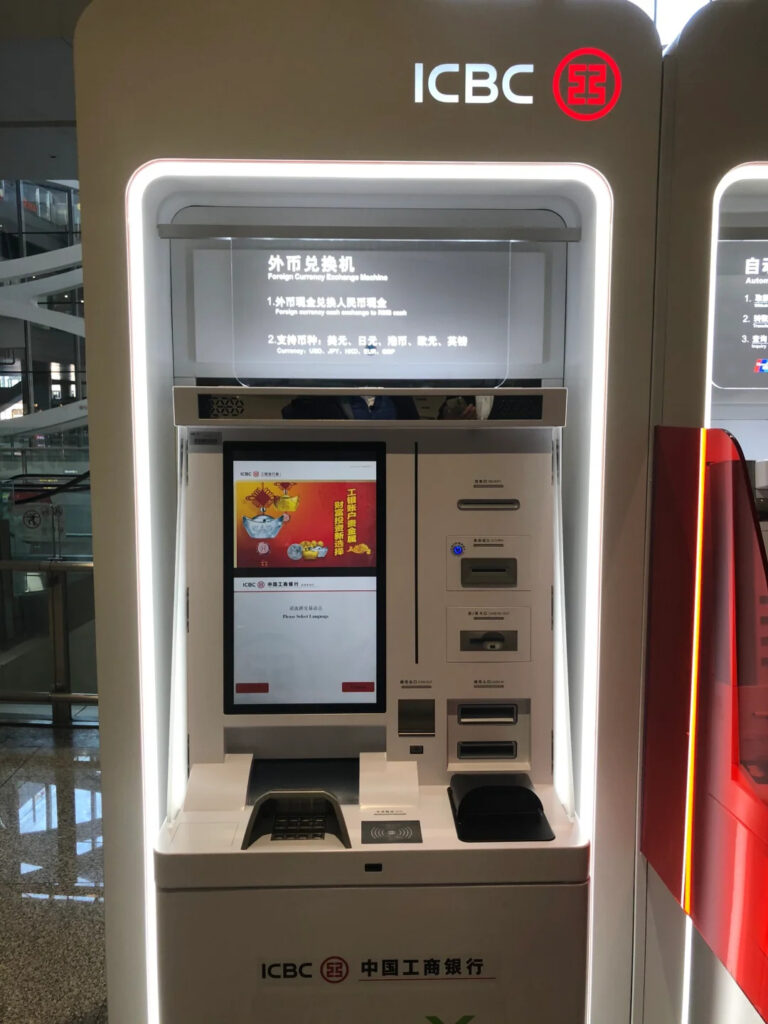
These machines are operated by banks, and you can often find them at airports and border crossings. They use the current exchange rate and do not charge a service fee. You’ll need cash to use them.
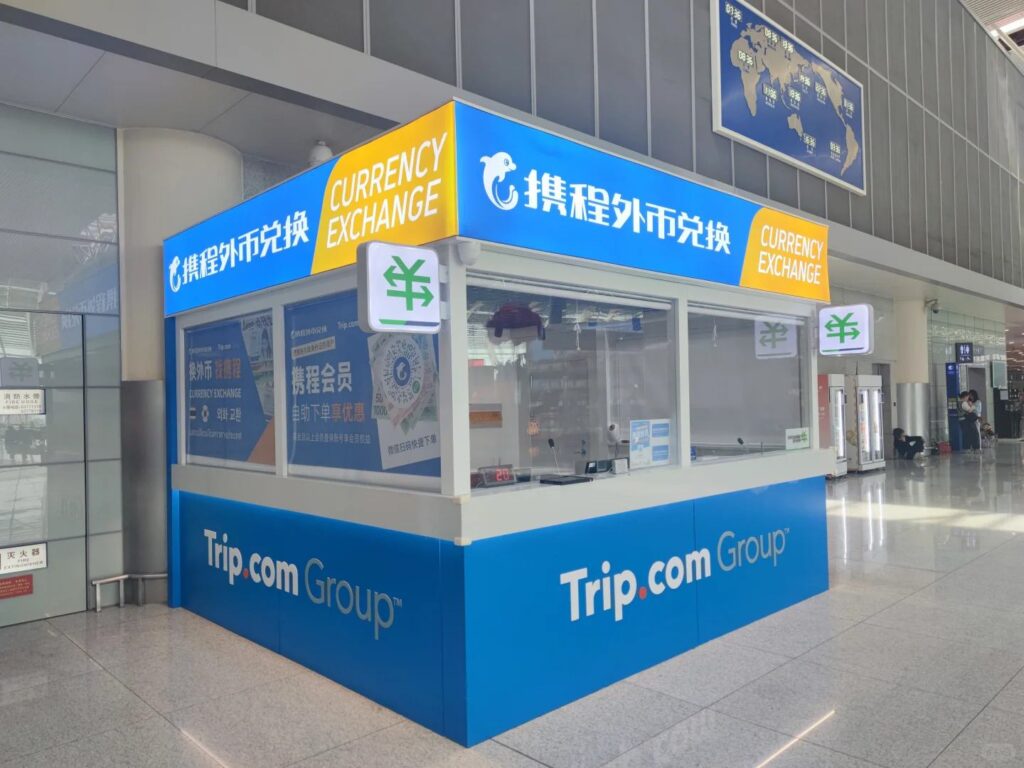
2. Currency exchange counters
These are also common at airports and border crossings, usually marked with signs like “Currency Exchange.” They’re staffed, so someone can help you through the process.
The counters let you pay by credit card, WeChat Pay, or Alipay instead of cash. They usually use the current exchange rate, but the service fee can be quite high, often around 10%.
3. ATM withdrawals
In all cities, certain ATMs let you withdraw cash with an international bank card, but not every ATM will work. Pick one that shows card logos like Visa, Mastercard, or JCB.
4. Exchanging money at a bank counter
You can also exchange money at a bank counter. Banks usually offer a current exchange rate, but the process can take a while.
Paying Directly with a Credit or Debit Card
Direct payments by credit or debit card are not widely accepted in China and many merchants don’t have card terminals that accept foreign cards. Card payments are more likely to be accepted at large shopping malls, upscale hotels, and businesses that regularly serve international visitors.
I would not rely on cards as your main way to pay, but paying directly by card may cost less when making a large purchase at a mall, hotel, or other business that accepts foreign credit cards because you can avoid the platform fees charged when you use an overseas card through Alipay or WeChat.
How to Pay for Subways and Buses
Most people in China pay for bus and subway rides using their phone.
All you have to do is pull up the transit QR code in Alipay or WeChat, then scan it when you board a bus or pass through a subway gate.
For ride-hailing, you can use the DiDi mini program in Alipay or WeChat. You book your ride there and pay in the app after the ride, so there is no need to carry extra cash.
Read More: Public Transport in China – Guide to Metro, Bus and How to Pay
How to Buy Tickets for Tourist Attractions
Many attractions sell tickets on-site, but you can also buy them online in advance to avoid waiting in line and to confirm whether tickets are still available.
For foreign visitors, I recommend booking attraction tickets through Trip.com and paying by credit card to avoid some of the fees charged by payment apps.
Summary
My most important pieces of advice are to set up both Alipay and WeChat before your trip, link a bank card to each app, and keep some cash as a backup.
Having both apps is important because if one app temporarily stops working, you will still have the other as a backup.
I also recommend having some RMB on hand. At airport self-service machines, you can exchange foreign currency for RMB at the displayed rate without paying a separate service fee. You can also use a credit card at a staffed exchange counter, although this option comes with additional fees.
PayPal, home e-wallets, and direct card payments may work for some travelers, but they are not as widely accepted as Alipay and WeChat, so I wouldn’t rely on them as your primary payment methods.
If you still have questions about paying in China, leave a comment below and I’ll do my best to help!