
Sacred Heart Cathedral in Guangzhou: How to Get There, Opening Hours, and What to See
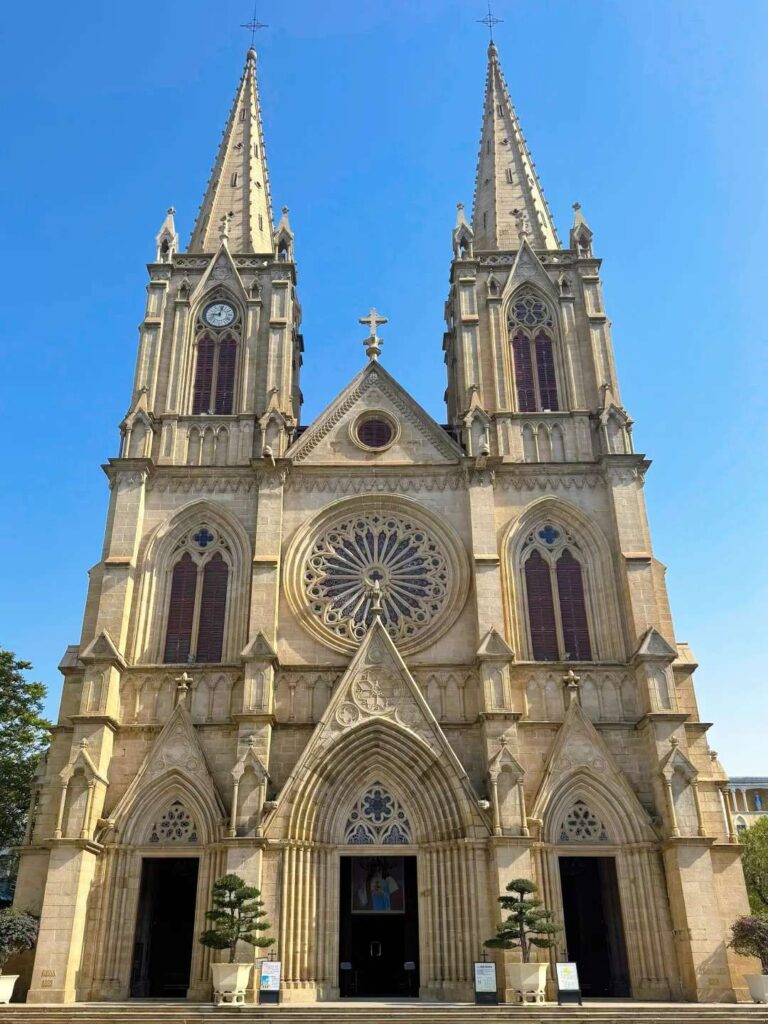
Sacred Heart Cathedral in Guangzhou is one of the city’s best-known landmarks and one of the few Catholic cathedrals in the world built entirely of granite.
Because Catholicism has never had a large presence in China, the cathedral is especially striking in central Guangzhou. It’s not only very impressive to see in person, but also has a complicated history that makes it all the more interesting. In my personal opinion, it’s worth going out of your way to see it during your visit to Guangzhou. (Read More: Things to Do in Guangzhou)
I lived in Guangzhou for several years and visited the cathedral a few times, so I’ve created this guide for how to get there, when to visit, and what to see and do while you’re there.
How to Get There
Sacred Heart Cathedral is in Guangzhou’s old city center, so it’s easy to reach. Here are the two best options:
By Metro
Take Metro Line 6 to Yide Lu Station and use Exit B. From there, the cathedral is about 400 meters away on foot.
By Taxi or Ride-Hailing App
Taxis in Guangzhou are generally affordable, so outside of rush hour, taking a taxi or using a ride-hailing app is often the easiest way to get there. Just search for “Sacred Heart Cathedral” as your destination.
Read More:
Essential Things to Do Before Traveling to China
Essential Apps you need for Traveling in China
Nearby Places to Visit
Shangxiajiu Pedestrian Street, one of Guangzhou’s best-known shopping streets, is very close to the cathedral. Beijing Road Pedestrian Street, Shamian Island, and Yongqing Fang are also about 10 to 20 minutes away by car. Canton Tower is a bit farther out, but you can still combine it with the cathedral if you’re planning a full sightseeing day.
Tickets
Admission is free.
Opening Hours
Keep in mind that this is still an active church, so the interior is not open all day. Check the opening hours before you go.
When planning your visit, it helps to know that there are two main areas: the church interior and the outdoor square.
Sometimes the square is still open even when the interior is closed, so you can usually at least see the exterior and take photos.
As of this writing, the hours are as follows:
| Day | Church Interior | Square |
|---|---|---|
| Monday | Closed | Closed |
| Tuesday–Friday | 9:00–11:00 a.m. 3:00–5:00 p.m. | 9:00–11:30 a.m. 2:30–5:30 p.m. |
| Saturday | 9:00–11:30 a.m. 1:00–2:30 p.m. | 9:00 a.m.–5:30 p.m. |
| Sunday | 1:00–2:30 p.m. | 7:00 a.m.–5:30 p.m. |
Note: On the third Sunday of each month, the church interior is closed all day for religious services.
Mass Times
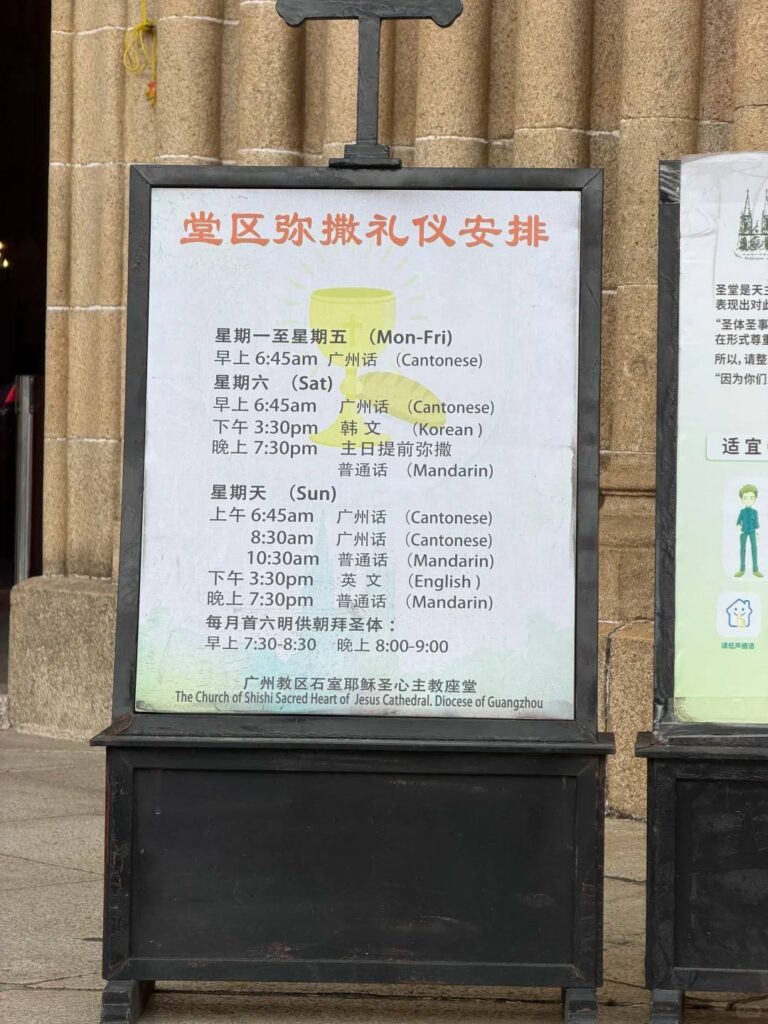
If you’re Catholic, you can also come for Mass. The cathedral mainly holds Chinese-language Masses, with Korean and English services at certain times during the week.
- Monday to Friday: 6:45 a.m. Cantonese Mass
- Saturday: 6:45 a.m. Cantonese mass; 3:30 p.m. Korean Mass; 7:30 p.m. Mandarin Mass
- Sunday: 6:45 and 8:30 a.m. Cantonese Mass; 10:30 a.m. Mandarin Mass; 3:30 p.m. English Mass; 7:30 p.m. Mandarin Mass
Things to Know Before You Go
- Because this is still an active church with regular services, dress respectfully if you plan to enter the church. Short skirts, shorts, tank tops, and flip-flops are not allowed. Shawls are available to borrow for free at the entrance.
- Keep your voice low while inside.
- Avoid walking around inside during services.
- Photography is not allowed during Mass.
How Sacred Heart Cathedral Came to Be
Seen from the street today, Sacred Heart Cathedral is very grand, and the area around it is quiet. The church’s beginnings, however, were anything but peaceful.
The cathedral’s history begins with the British and French invasion of Guangzhou in the late Qing dynasty. After the Second Opium War broke out in 1856, British and French forces captured Guangzhou and destroyed the residence of the Governor-General of Liangguang, who oversaw Guangdong and Guangxi at the time.
Afterward, missionaries proposed building a Catholic church on the site, but the governor-general refused the request. A French commander then demanded the land and threatened to place Guangzhou under military rule if it was not handed over within a day. This ultimatum from the French, backed by military force, is where the cathedral’s story begins.
Once the land was secured, French missionaries appealed to Napoleon III, then the emperor of France, and received major financial support. Construction began soon afterward. For the foundation ceremony, they brought one kilogram of soil from Jerusalem, said to have come from near the Tomb of the Virgin Mary, and another kilogram from Rome, both to be placed in the cathedral’s foundation. For the missionaries, the soil symbolized a connection between the new church to Jerusalem and Rome, and to a broader Catholic presence in the East.
More than 160 years later, the French missionaries are long gone, but the two foundation stones still stand on either side of the cathedral. They serve as a quiet reminder of the history that unfolded here.
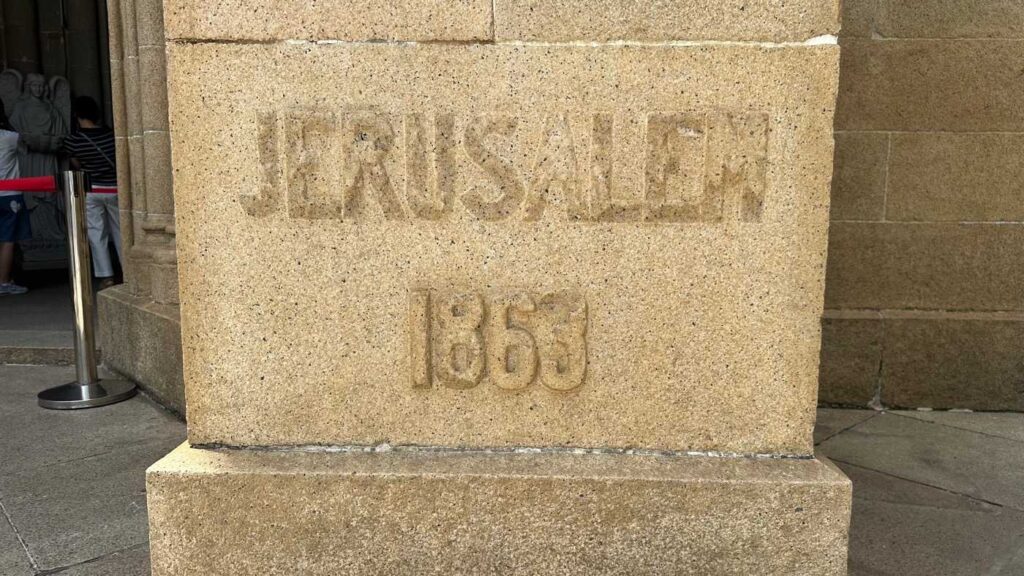
The foundation ceremony was held in 1863. It fell on the Feast of the Sacred Heart of Jesus, which is how the church got its name.
The Gothic Facade
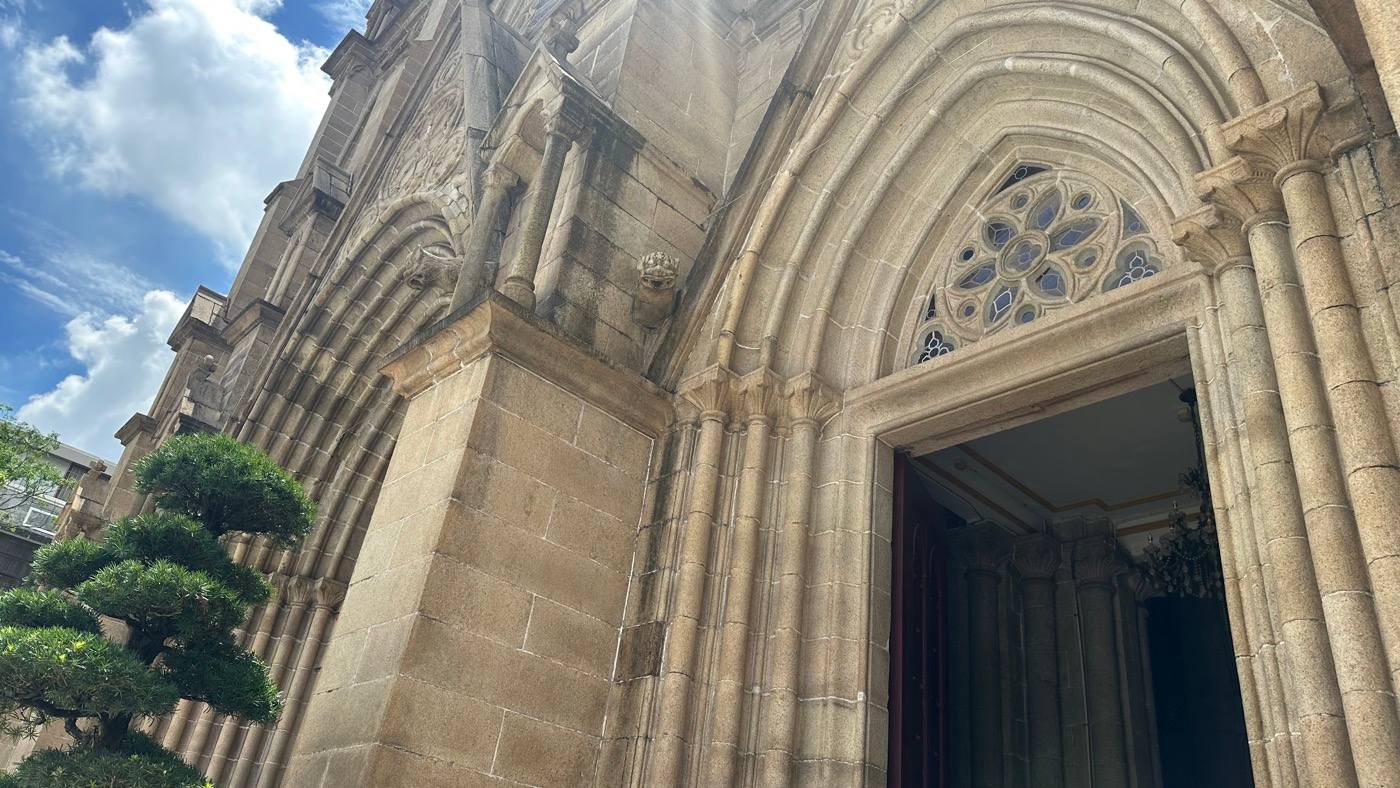
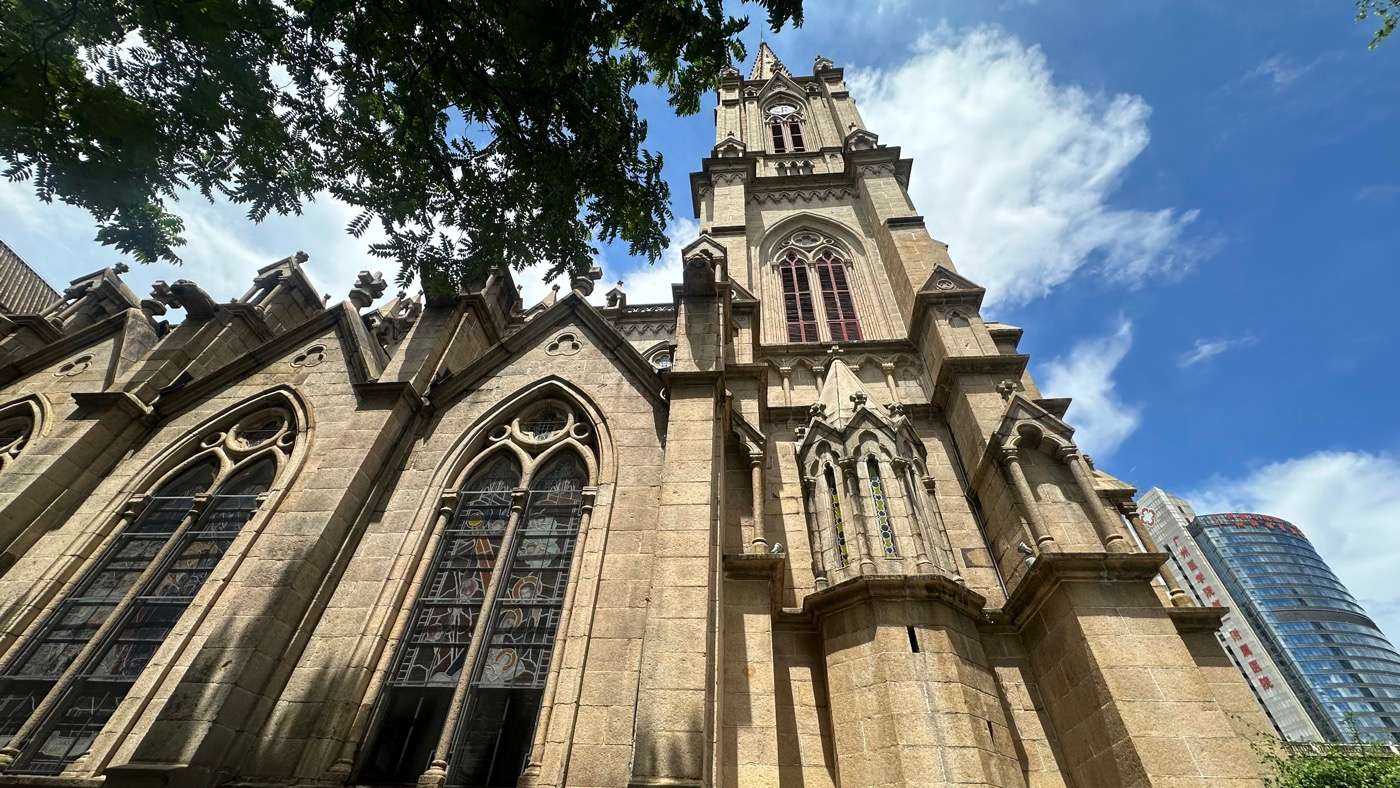
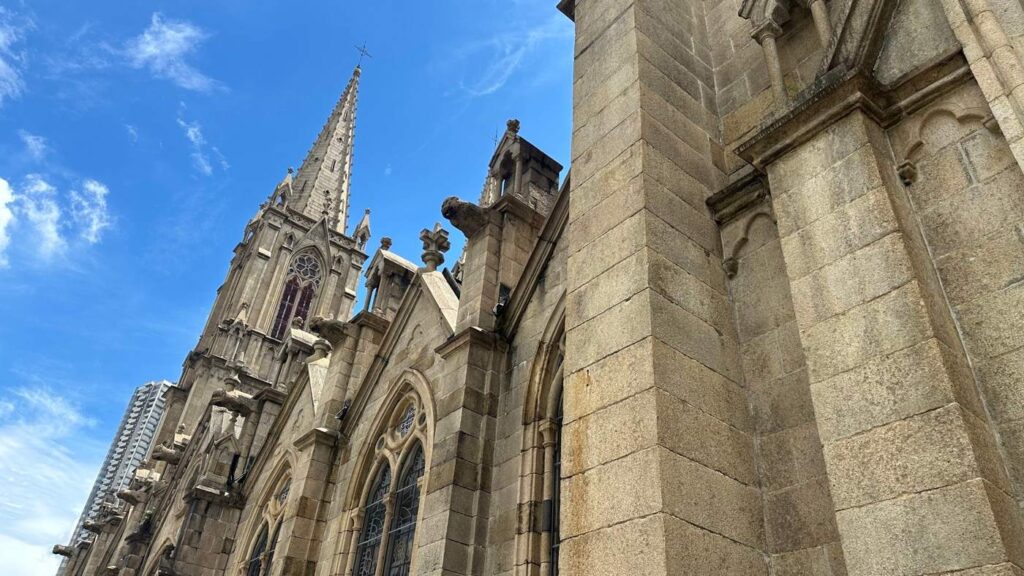
Sacred Heart Cathedral is one of the few churches in the world built entirely of granite, which is why it is also known as the Stone House of the Sacred Heart of Jesus. Its architecture is often compared to Notre-Dame in Paris. You can spot its grand facade before you even get close, but it still appears classic and not overly decorative.
Like many Gothic facades, it draws your eyes upward from the entrance to the towers. At ground level, the main pointed-arch entrance sits in the center, with smaller arched doorways on both sides. Above that, you will notice the stone carvings and decorative details, especially the rose window. Higher up, the Gothic style is most apparent in the bell towers, with two octagonal spires rising up sharply. The bell towers also house four large bronze bells brought from France.
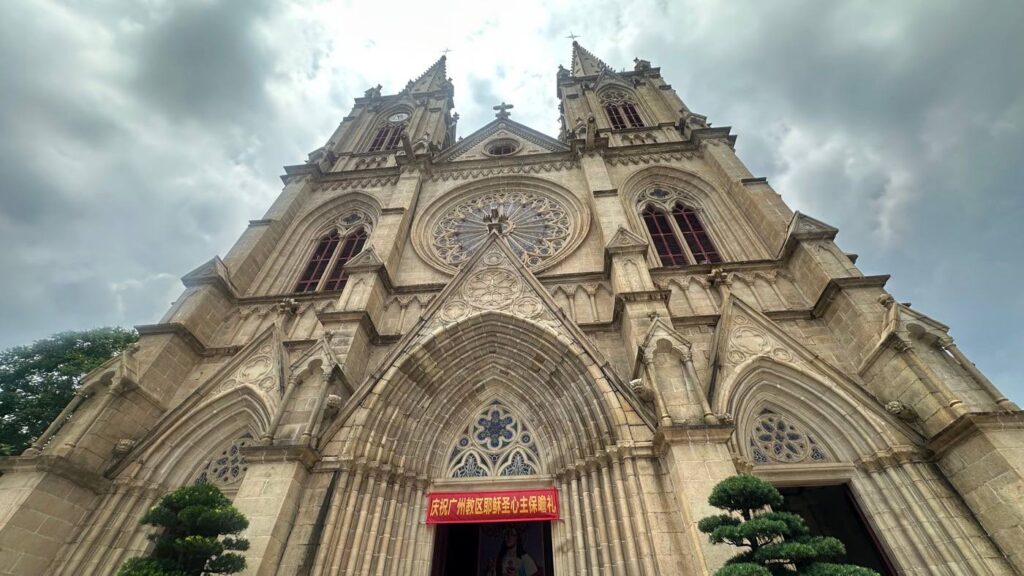
Another wartime story is also tied to the spires. During the war against Japan, a Japanese military plane struck one of them and crashed near the cathedral. The impact also shattered the cathedral’s valuable Napoleon III-era stained glass.
Damage and Restoration
Sacred Heart Cathedral was built in the aftermath of the British and French invasion of Guangzhou, and it was damaged again during the war against Japan. Over time, one upheaval after another left visible damage behind.
The problems did not end with the wars either. During the Cultural Revolution, the cathedral suffered some of its worst damage. Religious oil paintings, stained-glass windows, and much of the original decoration were smashed. Even the lion-head drain spouts on the roof were damaged with hammers. Even though the cathedral was already more than a century old by this point, it was once again caught up in turmoil. At one point, it was even used as a garbage dump.
Fortunately, the cathedral’s core structure remained intact, as most of the damage was to the decoration and exterior. In 2004, a major restoration finally began, with more than 10 million yuan invested in the project. The work continued until 2006, when the cathedral reopened. The interior walls, roof tiles, and granite exterior were all cleaned by hand, piece by piece. The bell tower, the most recognizable part of the facade, also had a mechanical clock installed again.
The restoration helped put the cathedral back on the map for visitors. It still carries its religious and historical meaning, but today it’s also one of the popular stops in Guangzhou.
The Cross-Shaped Layout
Before going inside, I recommend walking around the outside first. Almost every part of the building has a noticeably Western style, a sharp contrast to the Chinese gardens, pavilions, and traditional architecture you see elsewhere in Guangzhou. Even if you’re not especially interested in architecture or history, a walk around the exterior gives you a good feel for the cathedral’s quiet, solemn atmosphere.
Around the main cathedral, you will also see several smaller buildings, as is common around Western cathedrals. Traditionally, churches were often built with supporting facilities such as small hospitals, seminaries, and schools, so they were part of daily community life as well as religious life. These buildings are no longer used in these ways today, but knowing that history helps you picture what the cathedral complex once looked like.
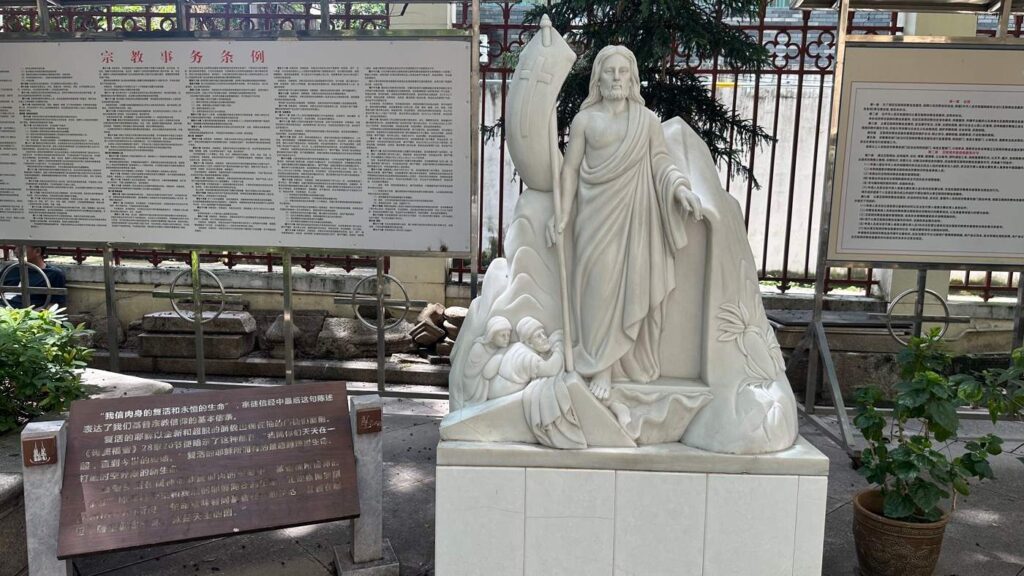
After walking around the outside, your first impression may be that the building is rectangular. From ground level, it’s hard to see the full layout, but it’s actually shaped like a cross. This is a classic Gothic cathedral layout, with the main entrance forming the lower end of the cross and the seating area forming the long central body, with the statue of Jesus Christ at the front.
Inside the Cathedral
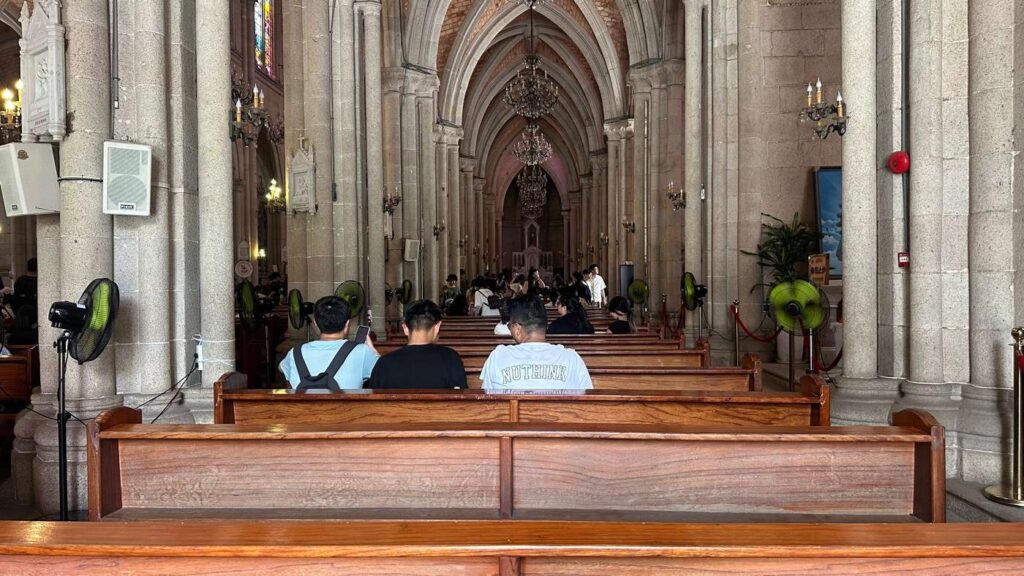
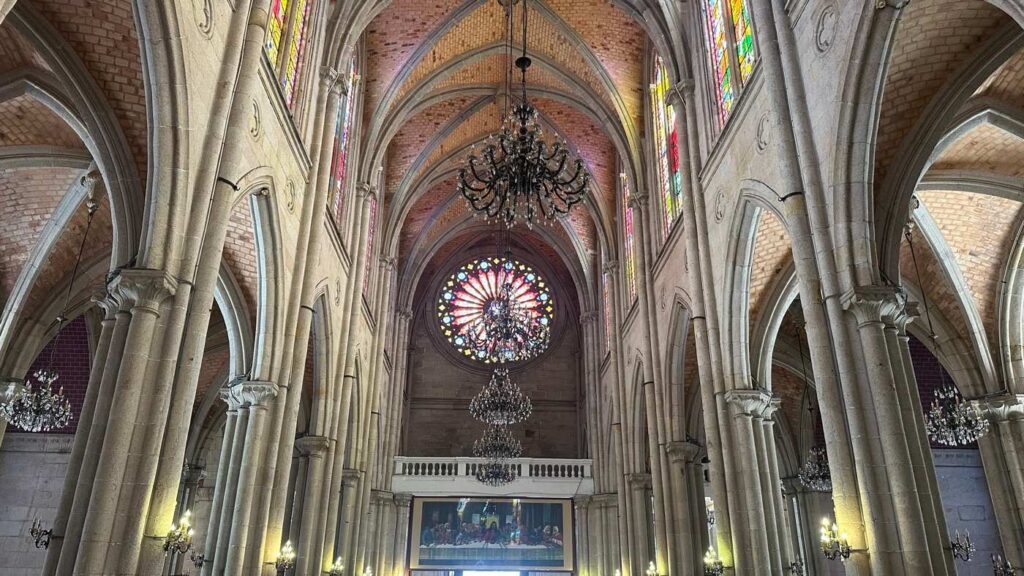
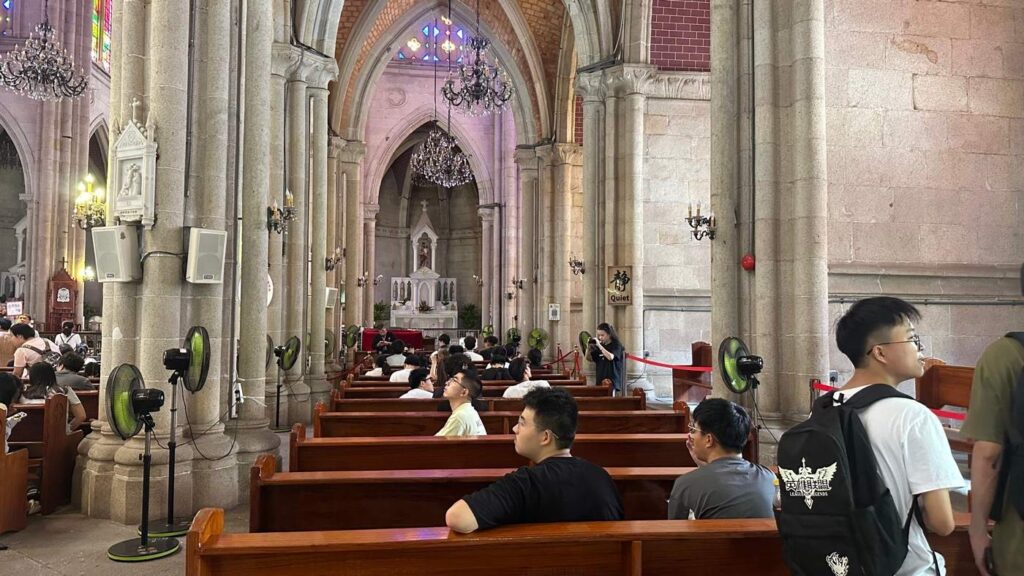
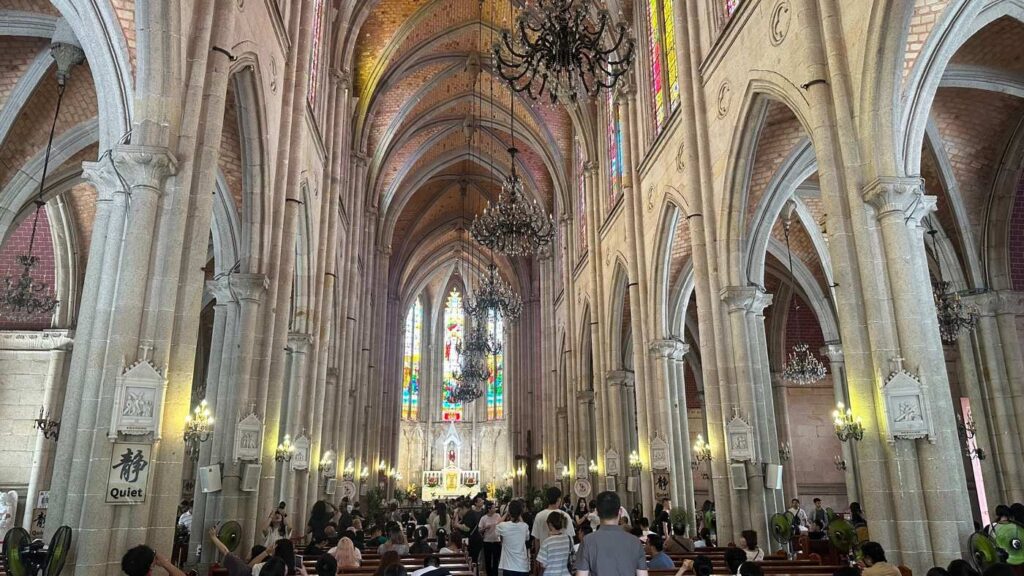
Once you step inside Sacred Heart Cathedral, many of the features will feel familiar if you have visited traditional Catholic churches before. And if you have walked around the exterior first, the interior will probably make more sense. Like the granite exterior, the interior is simple, restrained, and dignified.
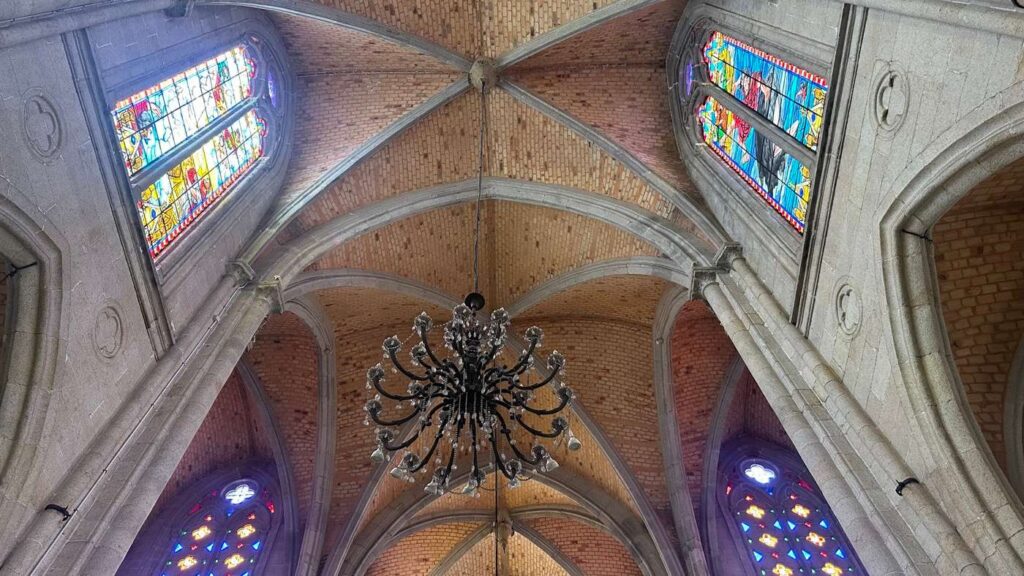
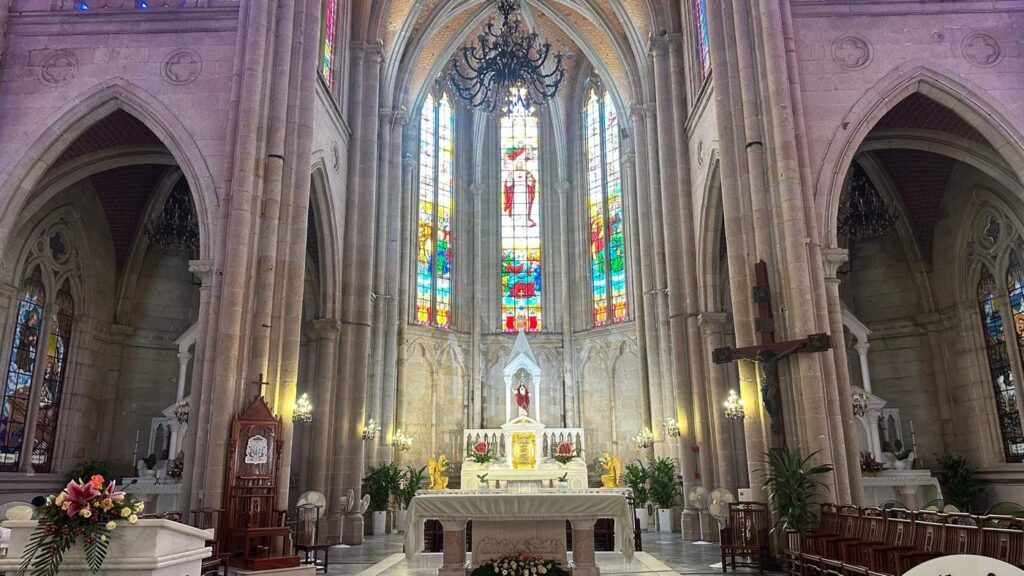
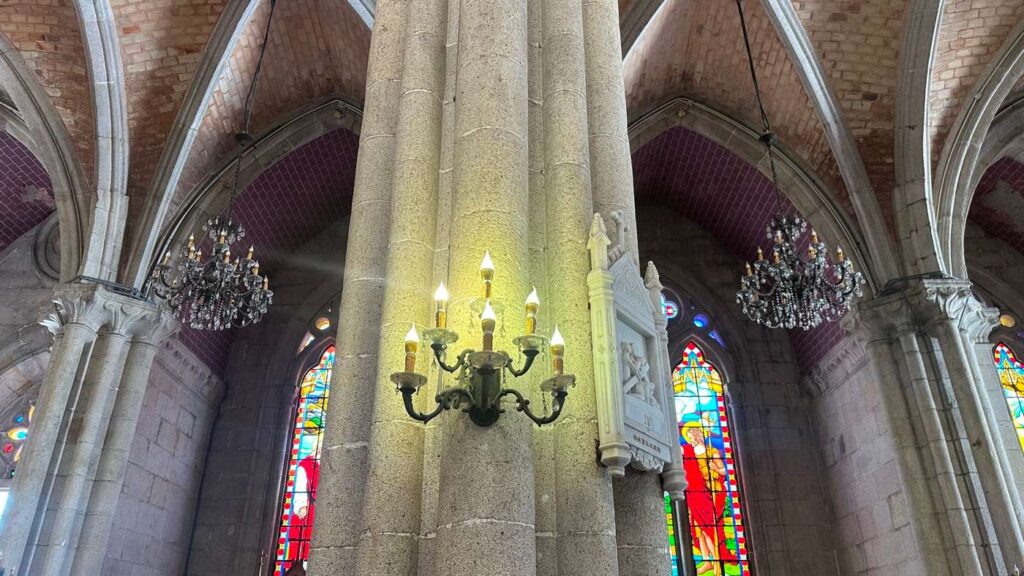
Three aisles run through the middle, dividing the seating, with additional passageways along the sides. The long central aisle leads straight to the front, with the statue of Jesus Christ at the front. Ten stone columns stand on each side, making the space seem larger and more formal. Above them, arches rise and cross overhead, naturally drawing your eyes up toward the ceiling.
The Stained Glass Windows
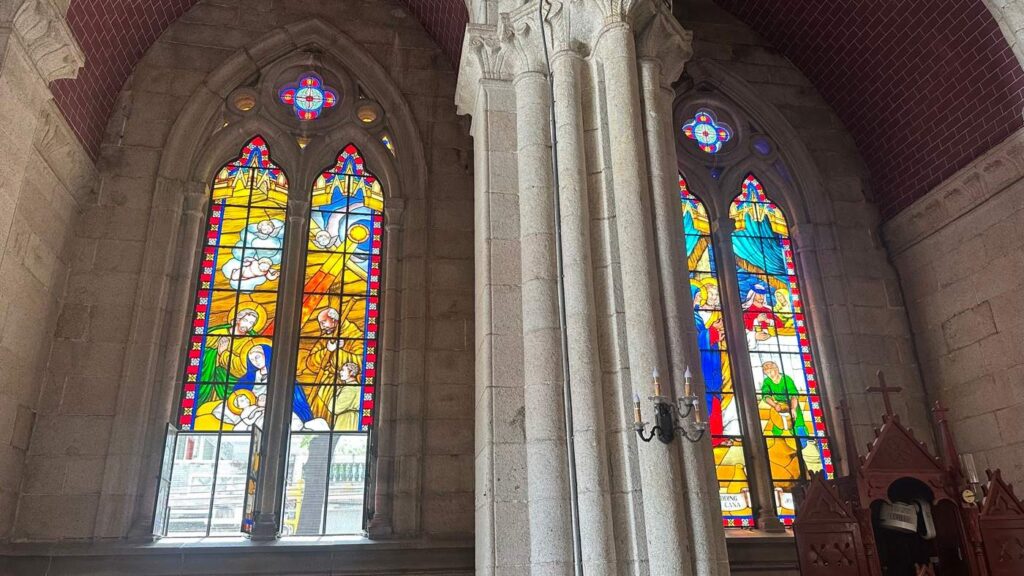
Because Sacred Heart Cathedral was originally built with French financial backing, its doors and windows were fitted with dark stained glass made in France. At the front entrance and along the sides, you can see large circular rose windows, each about seven meters across. In the center of each one is a small cross, with 24 petals pointing outward to represent the 12 saints of the Old Testament and the 12 apostles from the New Testament. The rose windows are colorful, but their tone is actually quite dark, an intentional choice to soften the direct sunlight and help keep the interior quiet and solemn.
The other windows were carefully designed as well, with a style inspired by Notre-Dame in Paris. Unfortunately, much of the original stained glass was damaged during the wars and political upheavals mentioned earlier.
The stained glass was not fully restored until the major restoration that began in 2004, which completed much of what visitors see today. Of the 20 million yuan restoration budget, 4.3 million yuan went toward restoring about 10,000 square meters of stained glass, which gives you a sense of how important the windows are to the cathedral. As part of the project, 98 specially made glass panels were brought in from the Philippines, each featuring Bible stories or religious symbols.
More Than Just a Photo Stop
Guangzhou’s Sacred Heart Cathedral is special but elegant. It’s unusual to find such a classic Gothic building in a major Chinese city, especially one originally built by the French. It has also survived more than a century of damage and restoration, and you can feel this history when you’re there. A visit here is not only about the architecture, and once you know a bit of its history, seeing the church is much more interesting.
If you have questions about Sacred Heart Cathedral or traveling in Guangzhou, leave a comment or send me an email and I’ll do my best to help!
Read More:
Where to Stay in Guangzhou
Guangzhou Travel Guide 2026: A 4-Day Itinerary for Sights, Food, and Culture


