Public Transport in China – Guide to Metro, Bus and How to Pay (2026)
China is a big country, and its major cities can feel just as big. Whether you’re visiting for work or traveling for fun, it helps to know the basics of getting around. I’m from China and travel around the country often, so here I’ll share how I’d use buses, subways, and other local transportation as a visitor.
Table of Contents
- Is Public Transportation in China Safe?
- Are Buses and metros Expensive in China?
- Is Public Transportation in China Easy to Use?
- How to Take the Subway
- How to Take the Bus
- How Do You Pay for the Bus or Subway?
- Taxis and Ride-Hailing
- Shared Bikes
- Final Thoughts
First, pick the right way to get around:
- Use the subway when there’s a convenient route. It’s usually the easiest option.
- If there’s no subway, or the subway route doesn’t work well for your trip, take the bus.
- If you have luggage, you’re short on time, or you’re arriving late at night, take a taxi or book a ride through an app. If your budget allows, you can use ride-hailing for much of your trip, as it’s often surprisingly affordable in China.
- For short trips of one or two kilometers, shared bikes are worth considering too.
And regardless of which type of transportation you use, make sure you have a few things ready before you head out:
- A charged phone with internet access
- A map app, ideally Amap/Gaode Maps
- A payment app, such as Alipay or WeChat Pay
- Know where to find the transit QR code in WeChat or Alipay
Is Public Transportation in China Safe?
Yes, it’s very safe overall.
China takes public transportation safety pretty seriously, with security checks at subway station entrances similar to those at high-speed rail stations. Things like gasoline and knives are not allowed through security.
For most travelers, bus and subway trips feel safe and uneventful.
Are Buses and metros Expensive in China?
In general, no. Public transport in China is very affordable.
Bus fares are usually 1–2 RMB.
In most midsize and large cities, a single bus ride usually costs 2 RMB, no matter how far you ride.
Smaller cities are often even cheaper. For example, in my hometown, a ride is usually 1 RMB, and it only goes up to 2 RMB in summer when buses run air conditioning.
Children under 1.3 meters (about 4 feet 3 inches) can usually ride for free. If your child is slightly taller than that, no one is likely to stop and measure.
Metro fares vary by city.
Metros are a little more expensive than buses because the fares are based on distance.
In Hefei, where I live, subway fares start at 2 RMB and go up from there depending on distance. Even so, it’s still very cheap. The highest fare is usually only 5 RMB.
Bigger cities are a little more expensive. In places like Guangzhou and Shanghai, fares usually start at 3 RMB, but rarely go above 7 RMB.
One reason fares are so low is that subway systems in China are publicly owned and heavily subsidized by the government. In many cities, buses and subways have run at a loss for years, with government subsidies helping keep them in service.
Is Public Transportation in China Easy to Use?
Yes, and overall it’s easier than many first-time visitors expect.
In most Chinese cities, public transportation is fairly easy to use, even if you’re visiting from abroad. The subway is usually the easiest transportation option because the stations tend to have better English signage and there’s staff around if you need help.
Buses can be a little trickier, especially because some bus stops show stop names only in Chinese. Still, if you’re comfortable using a navigation app like Amap, buses are easy enough to figure out.
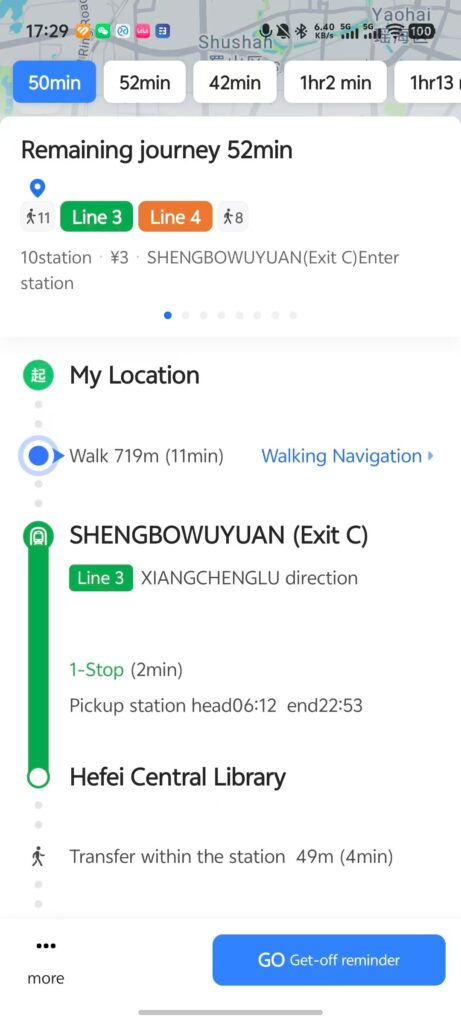
Amap supports English and is very useful for getting around. Enter your destination, choose public transit, and check which bus or subway line to take.
The app shows you how to get to the right stop or platform. It also shows where the next bus is, how long you’ll wait, how many stops you’ll ride, and roughly how long the trip will take. And when your stop is coming up, your phone will vibrate, so you don’t have to watch the route the entire time.
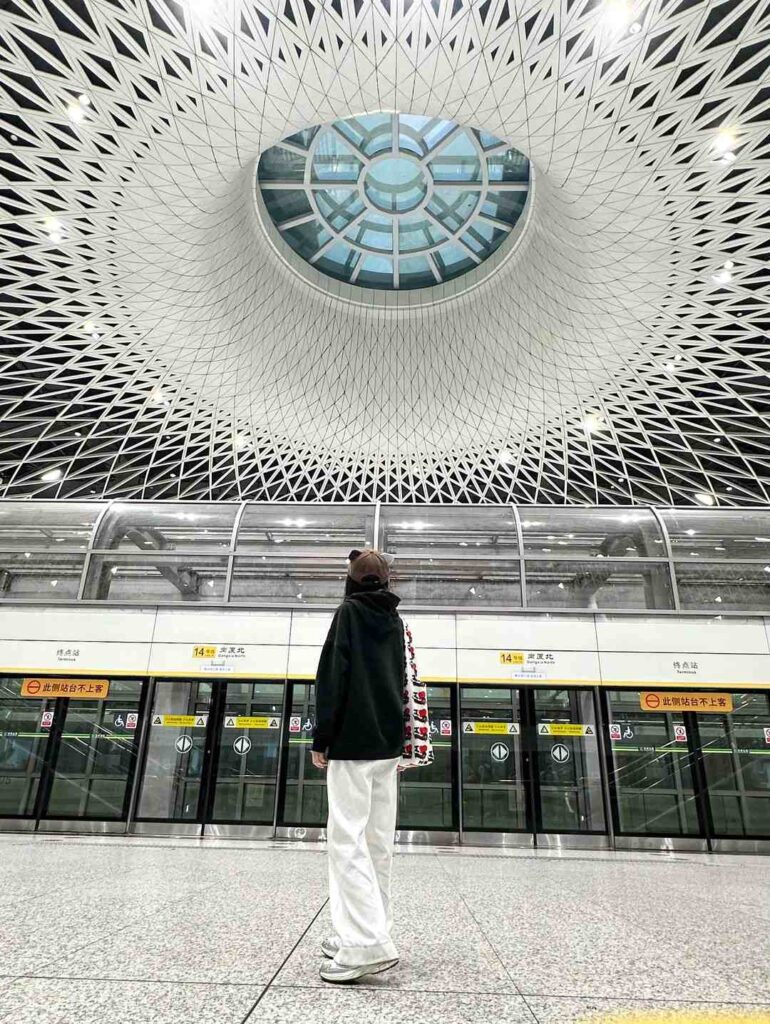
Public transportation in China is also clean and reasonably comfortable. In the summer, buses and subways are air-conditioned. The subway is especially comfortable, and each station has a unique look and feel.
How to Take the Subway
The easiest way to navigate the subway is to use Amap for directions.
Once you enter your destination, just follow the directions in the app and you’ll be fine. Amap will guide you to the nearest subway entrance. If you need to transfer, it will tell you where to change lines. When you arrive, it can also tell you which exit to take. Follow these steps to use the subway in China:
1, Find the metro entrance
If Amap shows a route that includes the subway, the stations are usually within walking distance from your current location.
2, Go through security
All subway stations in China require a security check before you enter. Knives with blades longer than 10 centimeters and flammable or explosive items are not permitted in the station.
3, Scan or tap to enter
If you’re buying a ticket at the station, get one from a service counter or ticket machine before going through the gate.
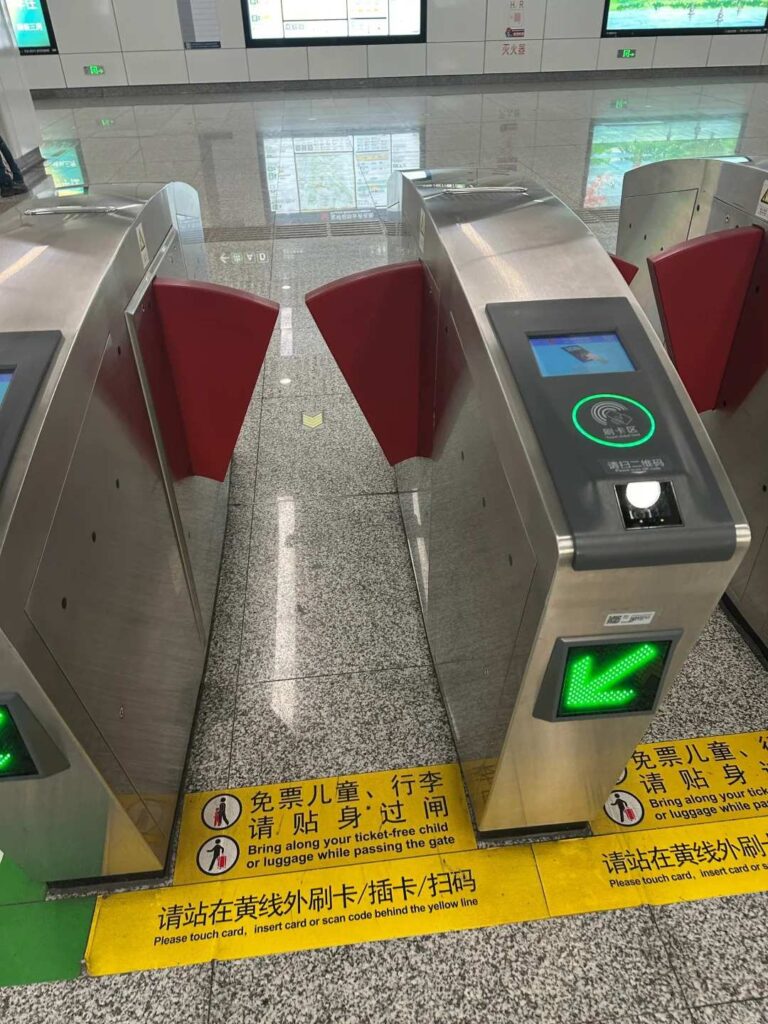
If you’re using a credit card or a transit QR code in WeChat or Alipay, just scan or tap at the gate to enter. I’ll explain the payment options, including ticket machines and transit QR codes, in the payment section below.
4, Check the direction of the train before you board
Follow the route in the app and make sure you’re boarding a train going in the right direction, which is the most common mistake visitors make. Subway signs usually include English, so they’re easy enough to follow, but if you’re unsure, ask the station staff for help.
5, Keep an eye on the station names and transfers
Keep an eye on your stop and any transfer stations along the way. The app makes this easy to track.
6, Scan, tap, or insert your ticket when you exit
As I said before, subway fares are based on distance, so you have to scan, tap, or insert your ticket when you enter and again when you exit.
If you’re using a transit QR code in WeChat or Alipay, or a credit card, scan or tap once when you enter and again when you exit.
If you’re using a credit card, make sure you use the same card both times.
If you bought a single-ride ticket at the station, you won’t scan it when you exit. Instead, you’ll insert it into the ticket slot at the gate, so be sure not to lose your ticket after you enter the station. The machine will keep the ticket.
How to Take the Bus
Bus routes are a little harder to navigate than subway lines, and bus stop information isn’t always shown in English, especially in smaller cities. This can make buses feel trickier than the subway, but if you’re comfortable using Amap, they’re easy enough to figure out.
After you enter your destination and choose public transit, Amap will show you which bus to take and how to get to the stop. After that, it’s pretty simple:
1. Go to the correct stop and wait for the bus
Amap shows you where your bus is in real time and roughly how long you’ll need to wait.
Less frequent routes can mean longer waits, so check the live arrival time before you leave and time your walk to the stop. For example, if the app says the bus will arrive in about 10 minutes, that’s usually a good time to head out. That way, you won’t be waiting around too long, especially in very hot or cold weather. Just adjust the timing depending on how far you are from the stop.
2. Get on and ride to your stop
When the bus arrives, pay in cash or scan the transit QR code in WeChat or Alipay as you board.
Bus fares are fixed, and in many cities, one ride costs 2 RMB.
I’ll explain how to use the transit QR code in the payment section below.
3. Get off at your stop
Make sure you know the name of your stop. On most buses, the current stop and the next stop are announced in both Chinese and English. Amap also shows your location in real time as you ride, and your phone will vibrate when your stop is coming up, so it’s easy to follow along.
Pro-tip: On most buses, you board at the front and get off at the back.
How Do You Pay for the Bus or Subway?
Whether you’re taking the bus or the subway, you can pay with cash or your phone. In some cities, buses and subways also accept credit cards, which can be helpful for international visitors.
1. Cash — works on both buses and subways
I don’t recommend relying on cash, especially for foreign visitors.
Not only will you need small RMB bills or coins ready in advance, but if you’re taking the subway, you’ll also need to buy a ticket from a machine or service counter first, which adds an extra step.
2. Pay with your phone — works on both buses and subways
WeChat Pay and Alipay are the easiest options. Once you have one set up, you can use the transit QR code in the app to take buses and subways.
Just make sure the code on your screen is the right one for the bus or subway. In many cities, bus and subway codes are separate, so you may need to switch between them manually.
For example, in Hefei, the bus code and subway code are in different sections of the transit QR code mini-program. If your screen is showing the subway code but you want to take the bus, you’d switch to “Hefei Tong.”
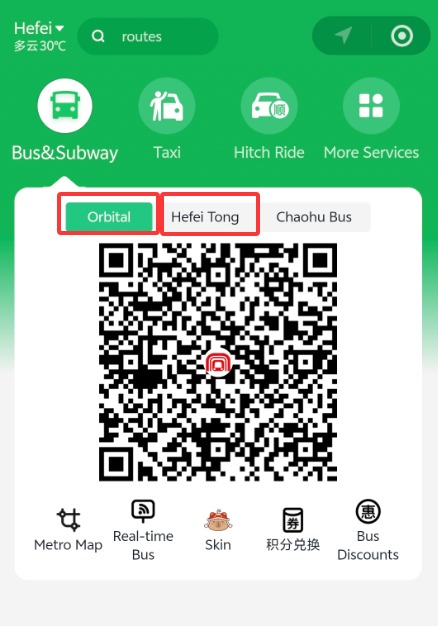
In Shanghai, by contrast, buses and subways use the same transit code. If you see “Bus & Subway” above the QR code, the same code works for both.
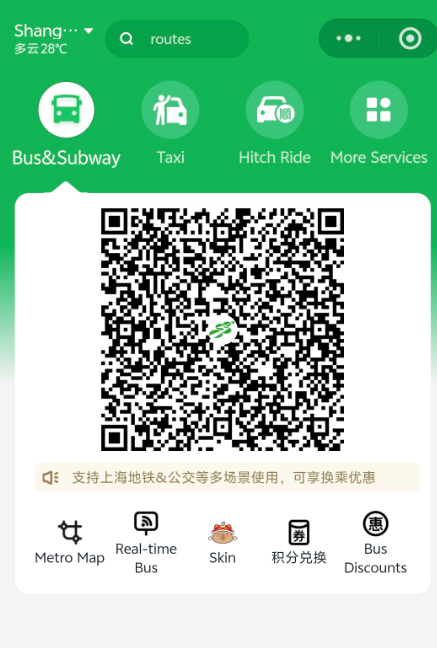
Pro-tip: The QR code refreshes often and expires quickly, so a screenshot won’t work later.
3. Contactless credit card — works only on the Metro
In several major Chinese cities, you can now enter and exit the subway by tapping a contactless credit card. For many foreign visitors, this may be the easiest option.
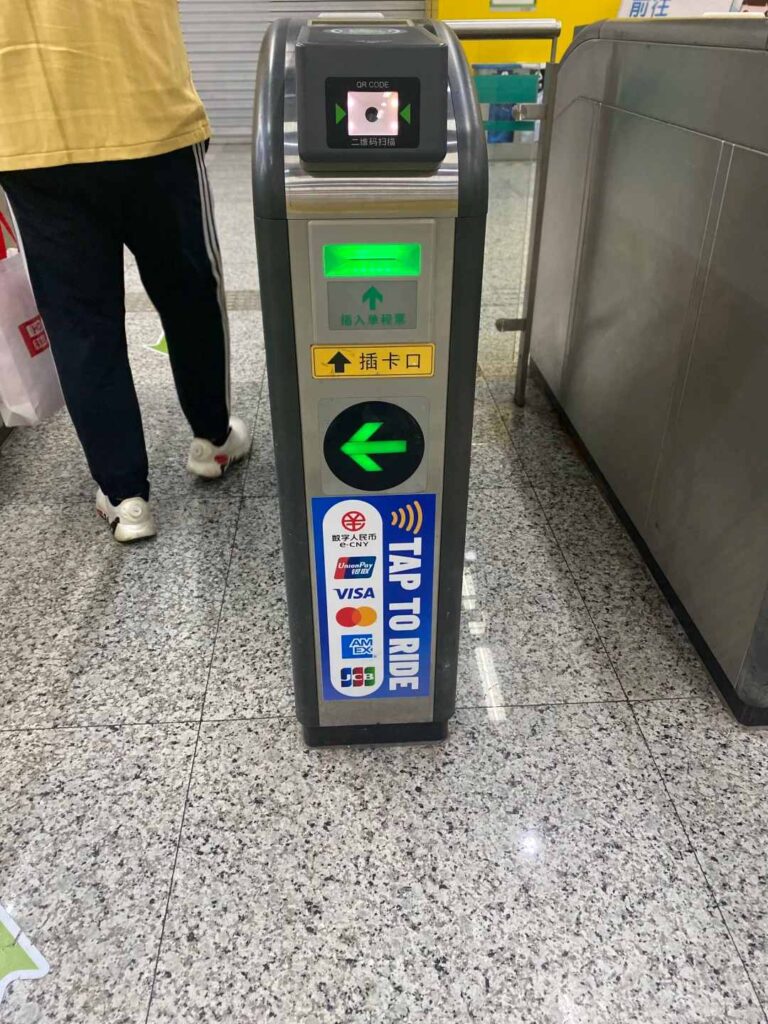
Physical bank cards aren’t used much day to day in China, so when a metro system accepts international cards at the gate, it’s usually aimed at making travel easier for overseas visitors.
A few things to note:
- Not every city supports this yet. As of my latest check, the main cities where you can tap a credit card at the subway gates include Beijing, Shanghai, Guangzhou, and Chengdu.
- Supported cards usually include UnionPay, Visa, Mastercard, JCB, and American Express.
- For buses, direct credit card payment is still uncommon.
4. Local transit card — usually not worth it for short trips
Most cities have their own local transit card, which you can buy at a subway station. In many cities, the card also gives you a small subway discount, such as 10% off each ride, but the card itself may cost around 10 RMB.
If you’re only visiting for a short trip, I don’t think it’s worth the hassle to get one.
5. Subway day passes — useful if you’ll be riding a lot in a short time
Some cities also offer subway day passes for visitors, which can be worth it if you plan to use the subway a lot over a short period of time.
They’re usually easy to buy too, available at the service desk in most subway stations. Still, it only makes sense if you’ll be taking the subway a lot, otherwise it probably won’t save you money.
Prices vary by city, but they’re often around 18–20 RMB per day. Once you use the pass for the first time, you can take unlimited rides for the next 24 hours. If you’re planning a busy sightseeing day, a day pass can be good value.
Some cities also offer multi-day passes that allow unlimited rides during that period.. For example, Guangzhou Metro and Shanghai Metro both offer 3-day passes: 50 RMB in Guangzhou and 45 RMB in Shanghai.
What If You Lose Your Transit Card or Credit Card?
If you lose your transit card or credit card, don’t panic. Just go to the service counter in the station and explain what happened.
Because staff usually can’t confirm where you entered, they’ll normally charge you the maximum fare. The amount varies by city, but it’s usually around 5–7 RMB.
Pro-tip: If you lose your credit card, lock it online as soon as possible after you leave the station.
Taxis and Ride-Hailing
If you have a large suitcase, you’re arriving late at night, your destination is out of the way, or you’re simply short on time, a taxi or ride-hailing car is usually the best option.
Taking a regular taxi works much like it does elsewhere. If the taxi’s light is on, you can wave it down and get in. Have your destination in Chinese on your phone or on paper so that you can show it to the driver.
These days in China, most people use ride-hailing apps instead, so I wouldn’t make a regular taxi your first choice. With ride-hailing, you can see the fare, pickup point, and route in the app.
For visitors, this helps you avoid problems like a driver taking a longer route or trying to overcharge you. It’s also easier because the driver can see your destination in the app, so you usually don’t need to explain much.
Ride-hailing in China is often very affordable, especially in small and midsize cities. If you’re traveling with other people, the total cost may not be much higher than public transport.
For example, the trip from my home to Hefei South Railway Station is about 11 kilometers. If four people take the subway, the total fare is 12 RMB. If those same four people book a ride together, it’s about 17 – 18 RMB.
That’s why many visitors, especially those from countries where rides are much more expensive, end up using ride-hailing more often in China instead of taking the subway everywhere. It also saves you from dealing with transfers and extra walking.
In larger cities, ride-hailing costs a little more, but it’s still relatively affordable.
In Shanghai, for example, the ride from Jing’an Temple to the Oriental Pearl Tower is about 8.5 kilometers and costs around 25 RMB (still under 4 USD). If four people take the subway instead, the total fare is about 12 RMB for the group.
The main thing to avoid is weekday rush hour. Traffic can get very heavy during the morning or evening commute, so a car may not be any faster than the subway.
How Do You Book a Car?
You can book one through the DiDi mini-program in Alipay or WeChat, or use the ride-hailing feature in Amap.
Personally, I use Amap more often because it already has route planning built in. Once I’ve checked directions, I can book a car without switching apps.
Shared Bikes
If your destination is close, such as one or two kilometers away, shared bikes are often a great option. A car can feel unnecessary for such a short distance, while the bus may be too slow or not go exactly where you need.
Shared bikes are very common in China, and you’ll see them lined up along the streets in both big cities and smaller ones. In many small and midsize cities, shared e-bikes are common too, which don’t require as much pedaling.
When I travel, there are definitely times when the bus or subway is the easier choice. But if the distance isn’t too far, I prefer to hop on a shared bike so I can see everyday street life and get a better feel for the city.
How Do You Use Shared Bikes and E-Bikes?
Shared Bikes
Open WeChat or Alipay and scan the QR code on the bike. Once it unlocks, you’re good to go. When you reach your destination, lock the bike manually to end the ride.
Shared E-Bikes
Shared e-bikes work in a similar way. Scan the QR code with WeChat or Alipay, and once the bike unlocks, you’re all set. The difference is, at the end, you need to scan again and finish locking the bike in the mini-program, or the ride may keep running.
There are two important things to know when using shared bikes:
Park in a designated parking area
Parking spots for shared bikes are usually easy to find, with marked areas along the roadside where you can leave them. Parking areas for shared e-bikes are often more limited, so you may need to walk a little farther to find a place to park.
If you don’t park in a designated parking area, you’ll be charged an extra 5–10 RMB.
Don’t ride too far out of the town/city
Whether you’re on a shared bike or a shared e-bike, try not to ride too far out of the town or city. If you do, you may not find an approved parking zone where the app will let you end the ride.
Final Thoughts
Once you understand the basics of how buses, subways, taxis, ride-hailing, and shared bikes work, getting around Chinese cities is easy.
Public transportation in China is generally very affordable, and in my experience, it also feels very safe. Once you know how to pay with your phone and use Amap for directions, it’s much easier than many first-time visitors expect.
If you have questions, feel free to leave a comment or send me an email. I hope your trip to China goes smoothly!