Beijing Road Pedestrian Street in Guangzhou: Things to Do, How to Get There, and Practical Tips
Beijing Road Pedestrian Street is in the heart of Guangzhou’s historic center and has been one of the city’s main commercial streets for more than a thousand years.
Today, it remains one of Guangzhou’s busiest shopping areas, packed with shops, malls, snack stalls, and crowds. But even though it’s a modern commercial center, you can still see some details from Guangzhou’s long history.
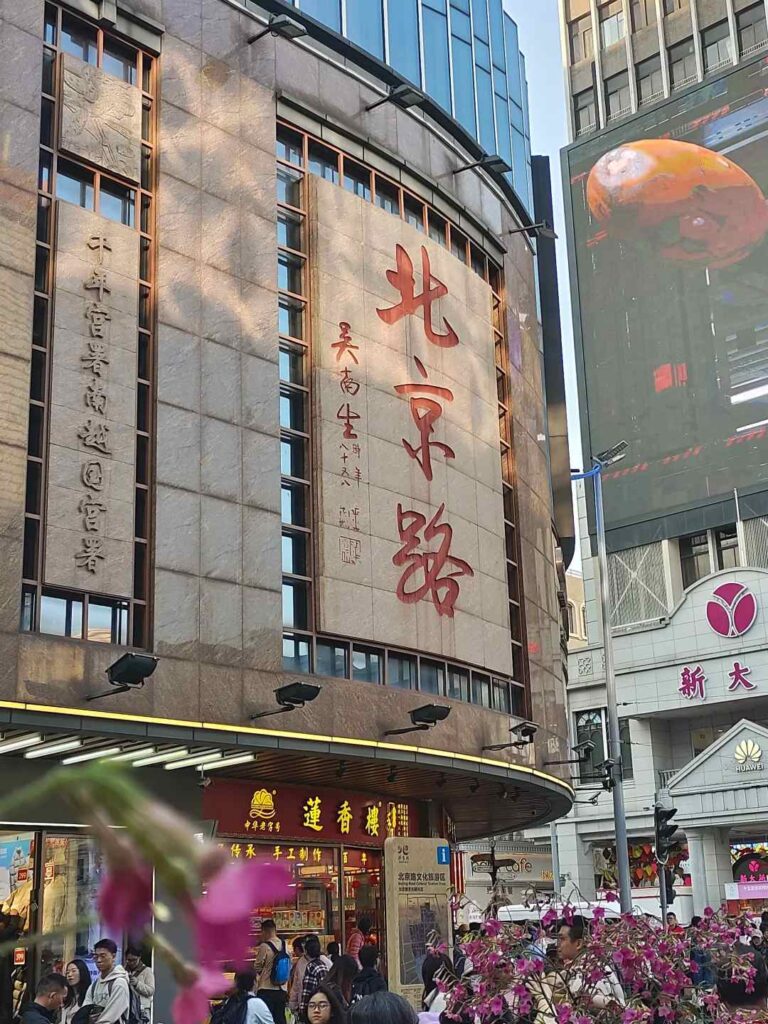
Personally, Beijing Road is one of the first places I’d recommend if you’re visiting Guangzhou for the first time. This guide explains what makes it worth visiting and what you can expect when you go.
How to Get to Beijing Road Pedestrian Street
The Beijing Road Pedestrian Street area is easy to reach, and several metro lines can take you there.
You can take Guangzhou Metro Line 6 to Beijing Road Station. Use Exit B, and you’ll come out right by the entrance to the pedestrian street.
You can also take Line 1 or Line 2 to Gongyuanqian Station. From Exit E, it is about an 800-meter, or half-mile, walk to Beijing Road.
People’s Park is also near Gongyuanqian Station, and it’s worth a quick stop if you have time. It is a nice place to enjoy some greenery and see Lingnan-style landscaping.
What to Do on Beijing Road Pedestrian Street
Shop for Almost Anything
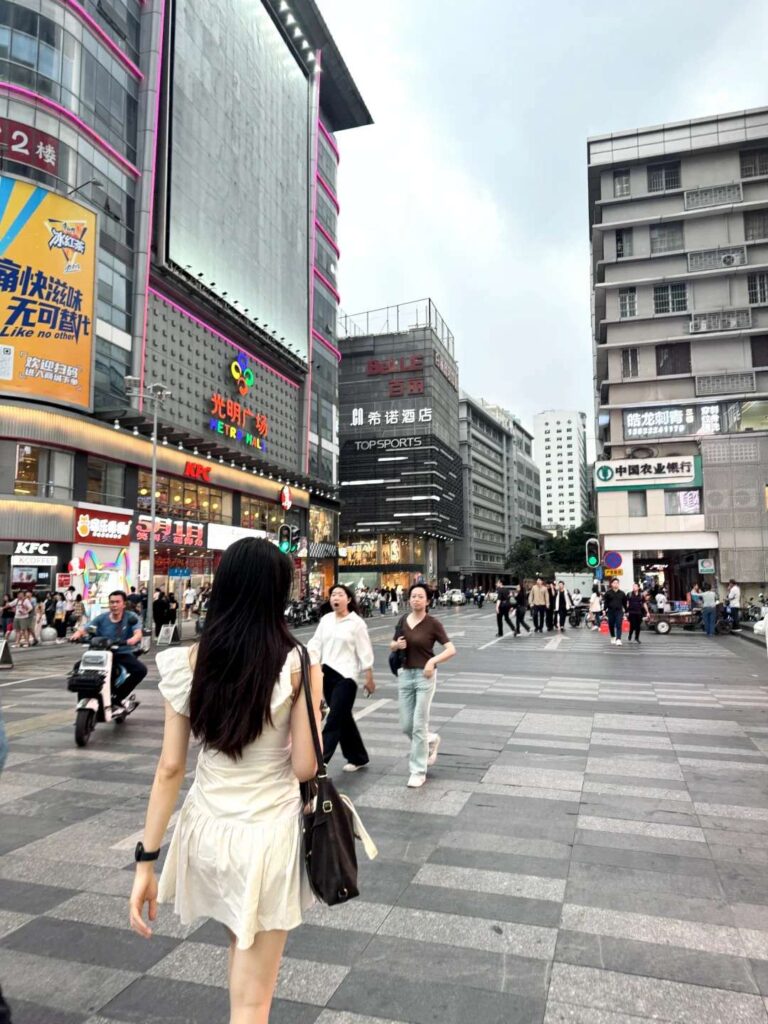
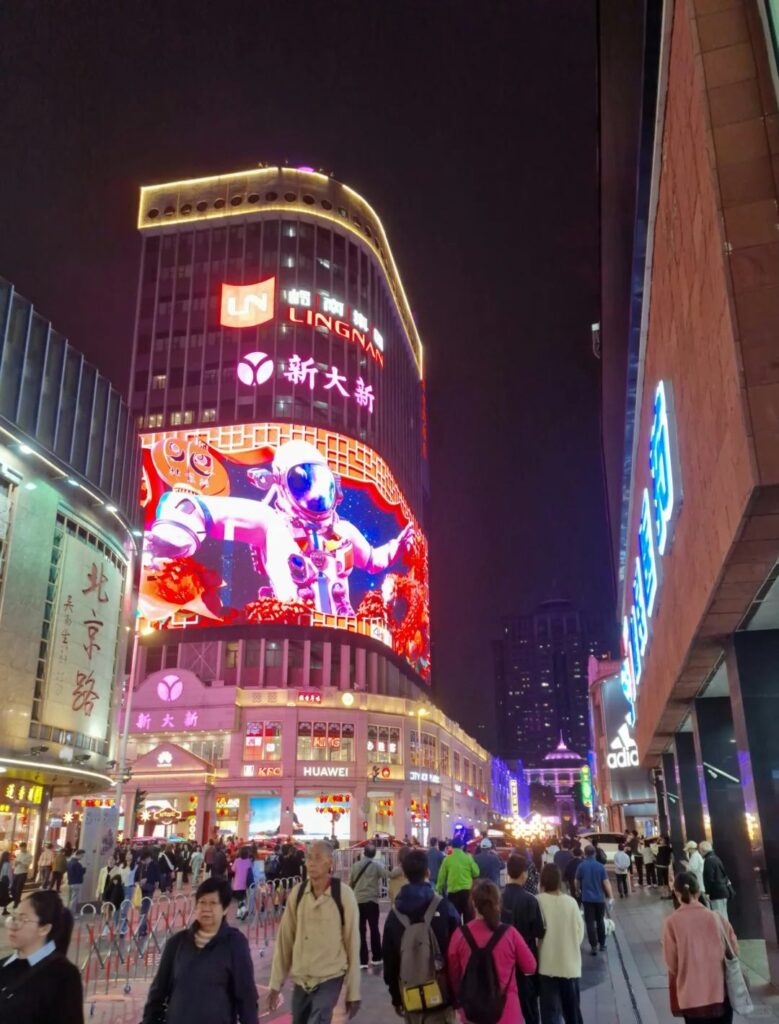
Beijing Road Pedestrian Street is surrounded by malls, making it one of Guangzhou’s main shopping areas. You’ll find all kinds of stores in the area, and you can buy almost anything you might be shopping for.
As you walk down the street, you’ll see shops on both sides, including Chinese and international clothing brands, shoe stores, local souvenir shops, and lots of snack stalls.
There are also small specialty shops and local stores that have been there for many years. These are good places to look for Guangdong handicrafts, Cantonese embroidery, aged dried tangerine peel, tea, and commemorative stamps.
Aged dried tangerine peel, or chenpi in Chinese, is common in Guangdong, and I’d recommend buying a little to try. It’s made from citrus peel that has been dried and aged, and people use it in tea, desserts, and herbal dishes. My dad and I both like using it to make tea at home.
There are several large malls in the area too. The malls are nice if you want more shopping options, air conditioning, or somewhere comfortable to sit for a while, which is especially nice during the hot and humid summers in Guangzhou.
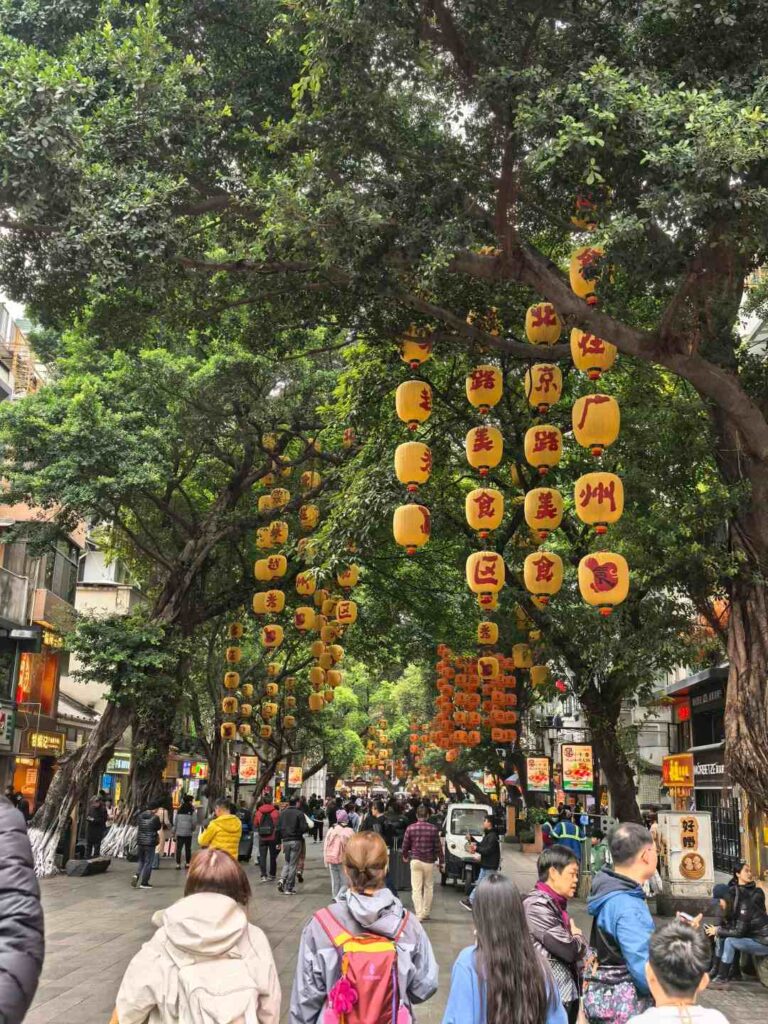
Beijing Road is often crowded, but that is part of the experience. The shops, snack stalls, and constant flow of people give you a sense of what everyday life is like in Guangzhou.
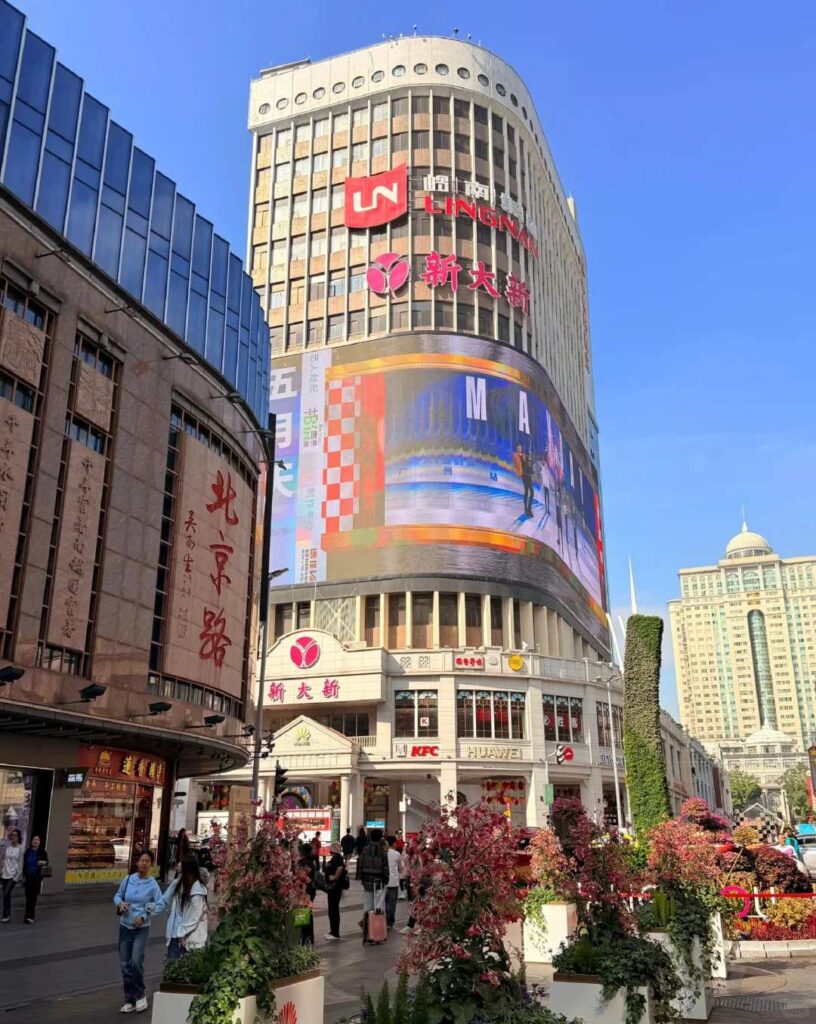
I especially recommend MINISO LAND and TOP TOY, which are both part of the MINISO Group, but different from each other. Both opened on Beijing Road in 2025 and quickly became popular with younger visitors and families.
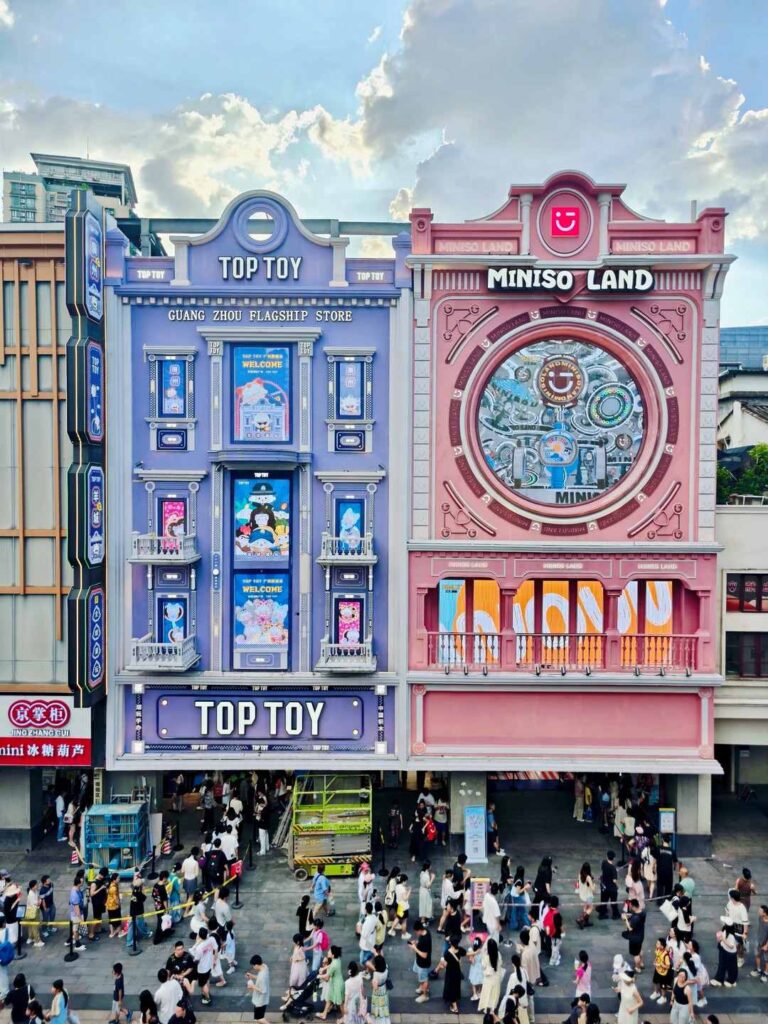
MINISO LAND is almost like a small theme park, built around familiar characters like Disney, Sanrio, and Harry Potter, along with MINISO’s own characters, such as Youyoujiang. There are character-themed displays everywhere, so it’s a fun place to browse through and pick up a few cute things.
TOP TOY is focused more on designer toys and pop-culture collectibles. You’ll find blind boxes, designer and artist figurines, model kits, and building sets. If you’re interested in collectibles or figurines, you’ll probably find it more interesting than a regular variety store.
The History That Makes Beijing Road Different
If Beijing Road were only about shopping, it might not feel all that different from the popular pedestrian streets in other big cities. But what makes Beijing Road Pedestrian Street unique is its history.
Beijing Road’s history goes back more than 2,000 years to the Qin Dynasty. After Qin Shi Huang brought the Lingnan region under imperial rule, this area became part of Guangzhou’s early urban development. Later, the Nanyue Kingdom built palace buildings and administrative offices nearby, helping the area grow in importance.
It may be hard to imagine what the street looked like so long ago, but even today, you can see traces of its long history along the street.
The Ancient Road Ruins
As mentioned earlier, Beijing Road Pedestrian Street was already a busy commercial area in ancient times, and the ruins beneath the street show just how far back that history goes.
In 2002, during a routine street renovation, workers noticed that some of the buried bricks looked unusual. Archaeologists were brought in soon after, who found layers of old road surfaces beneath the modern street, some more than a thousand years old.
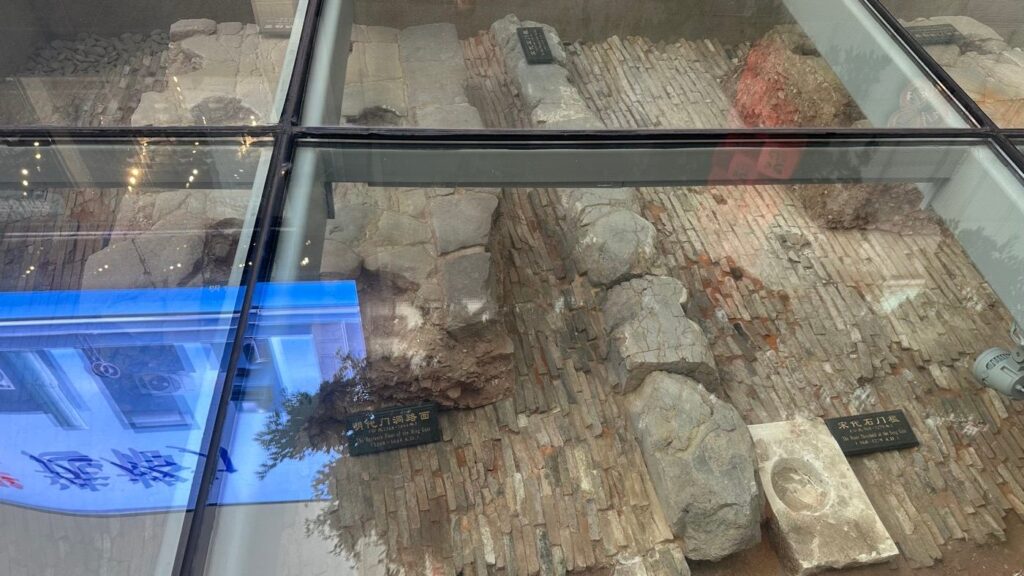
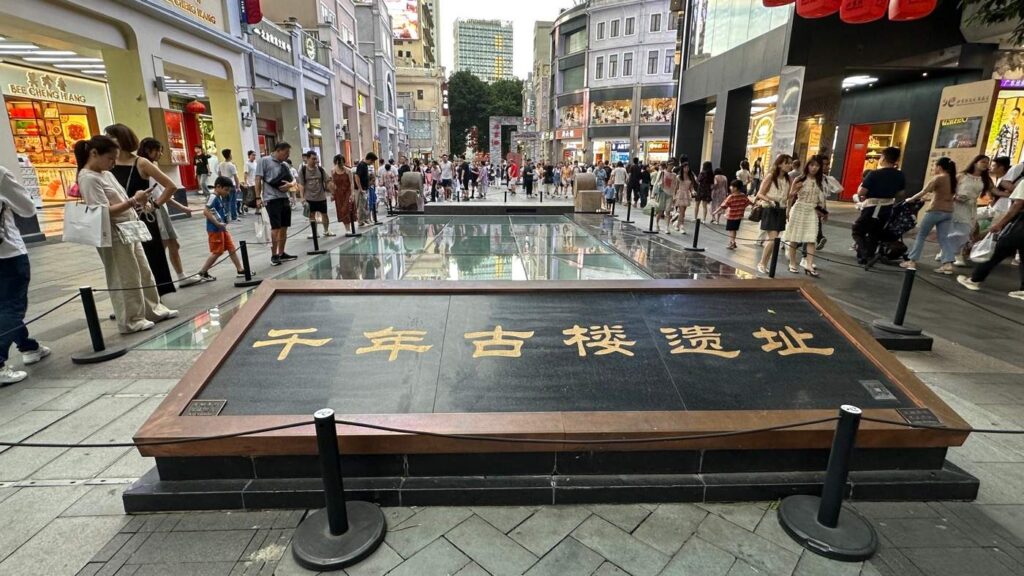
As the excavation continued, archaeologists found that the ground beneath Beijing Road had preserved layer upon layer of the street’s past. More than three meters below the surface, they uncovered 11 layers of road surfaces from five different periods, from the Tang Dynasty to the Republican era.
Today, these stone-paved roads from different dynasties are preserved beneath tempered glass. You can look down through the glass and see parts of the old road clearly. Comparing what’s under your feet to the busy street around you shows how far the history of this road has come.
The Yuan Dynasty Bronze Water Clock
In the middle of the pedestrian street, where the two main sections of Beijing Road meet, is a bronze water clock from the Yuan Dynasty. A bronze water clock was an ancient Chinese way of telling time, using water instead of gears or hands.
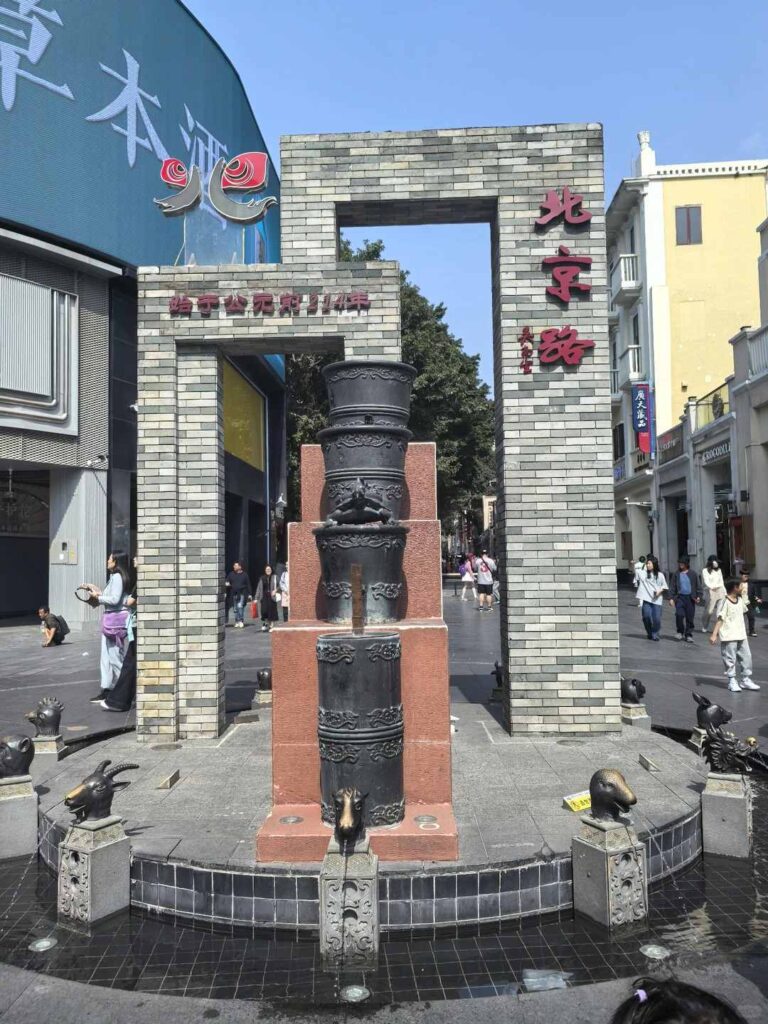
The original design used three water containers stacked vertically, with water dripping from one container into the next. In the center was a bronze ruler marked with the 12 traditional Chinese time periods and in front was a wooden marker that floated on the water. As the water level rose, the marker moved up with it. By checking the marker’s position, people could estimate the time.
Some historic sites, like the old buildings on Shamian Island, have been preserved where they were built. The original bronze water clock, however, was moved to the National Museum of China for conservation.
The bronze water clock you see on Beijing Road today is a reconstruction on the original site. It maintains the general look of the original, with a traditional double-arch structure and dripping-water pots around it that represent the 12 Chinese zodiac animals.
It’s also a good spot for photos!
Dafo Temple
Dafo Temple is right next to Beijing Road Pedestrian Street. Its name comes from the three six-meter-tall bronze Buddha statues in the main hall.
The temple’s history dates back to the Northern and Southern Dynasties, so it has been part of Guangzhou for more than a thousand years. If you walk from the metro station toward the pedestrian street, it’s hard to miss.
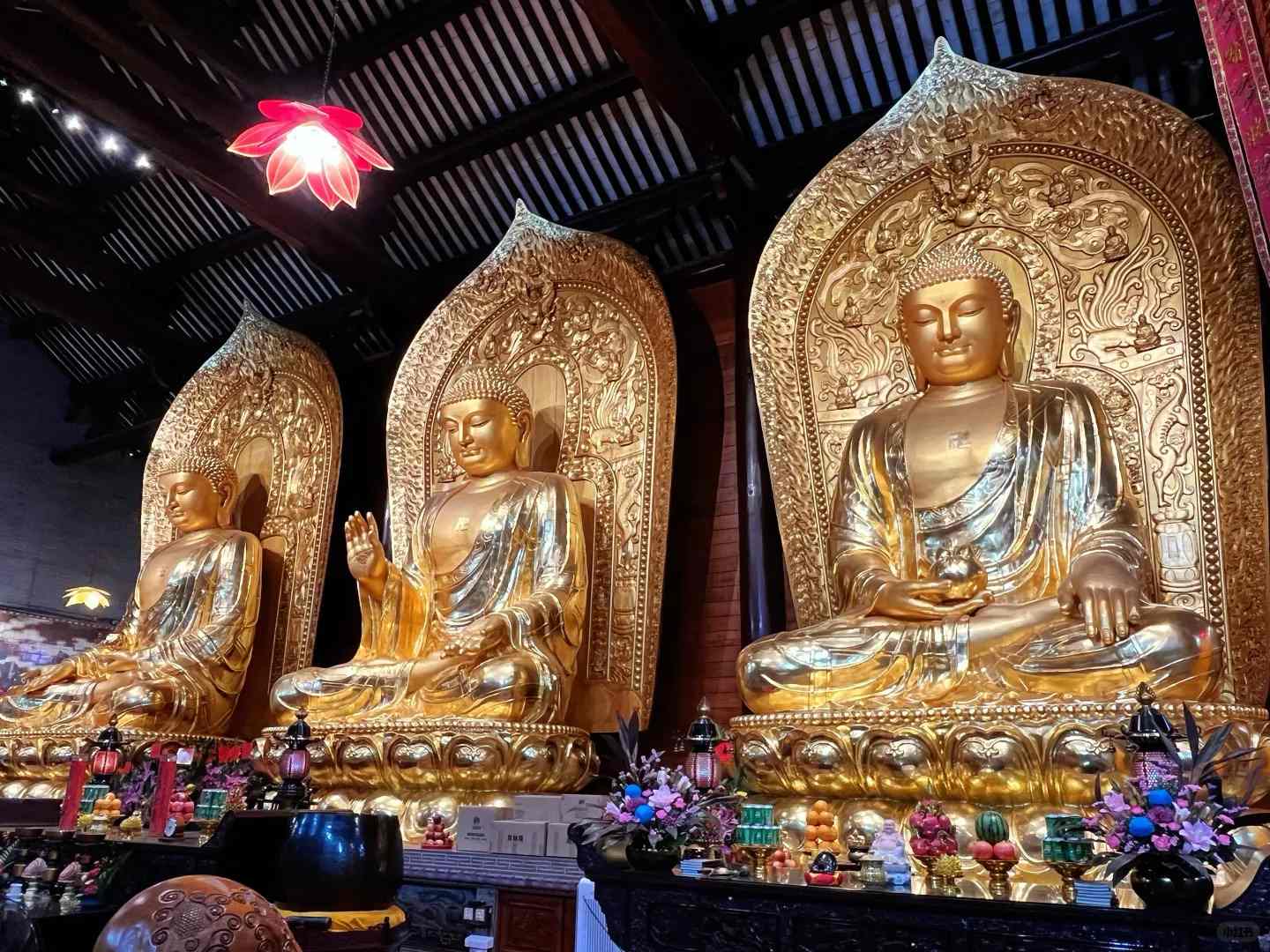
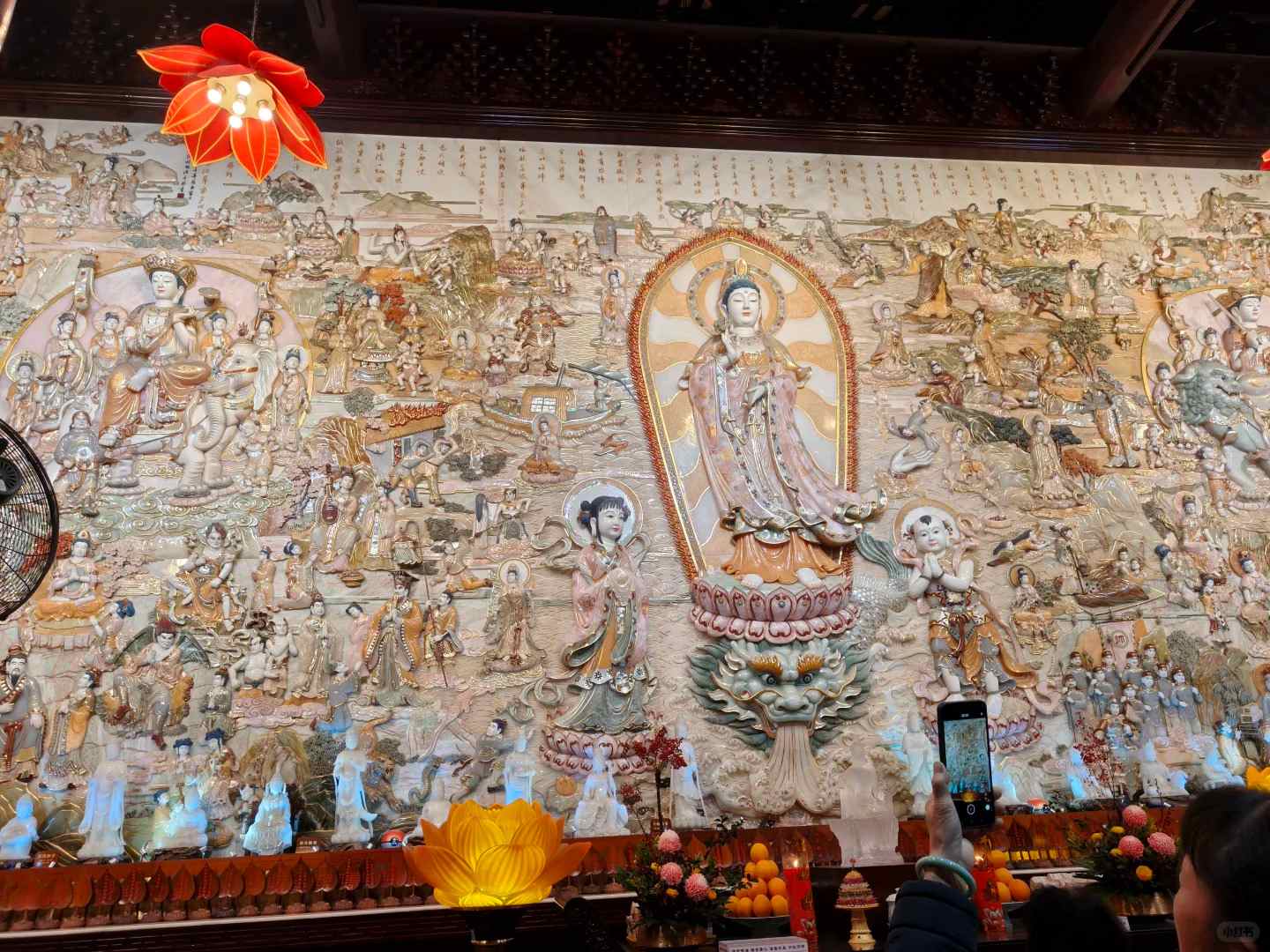
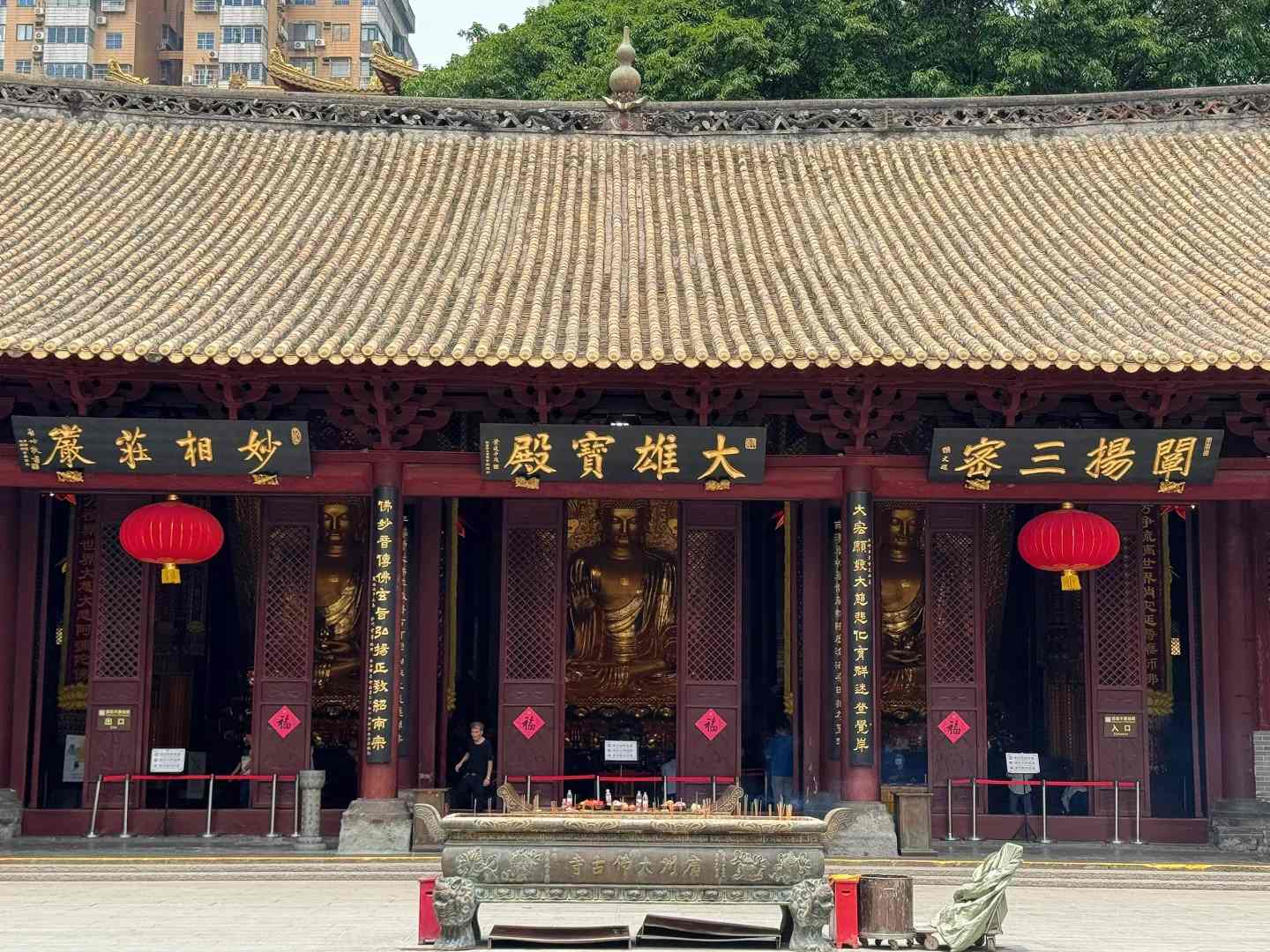
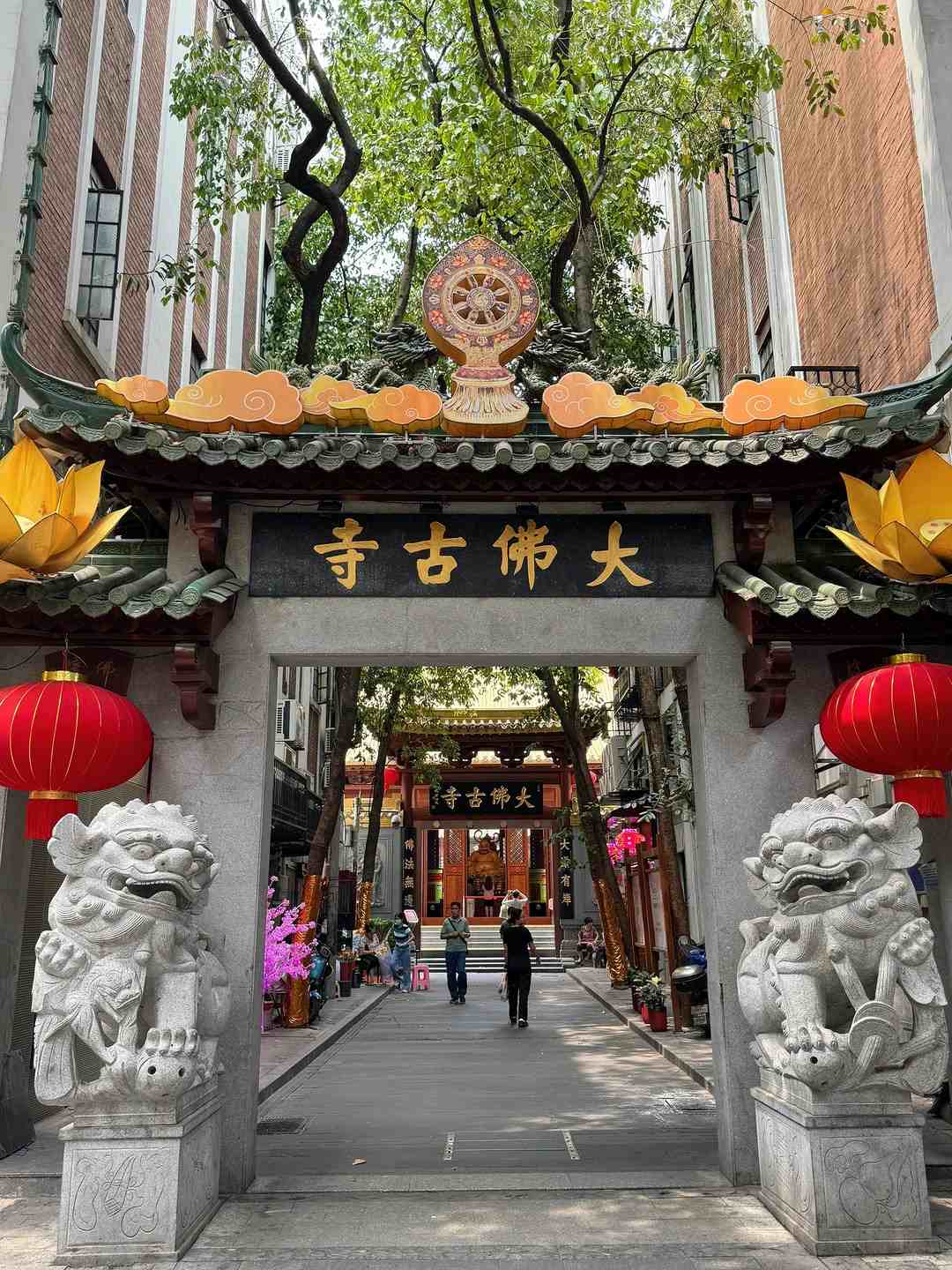
At the main entrance, you’ll see large statues and paintings, and many visitors stop here to worship. There are small side gates as well, and I would suggest stepping inside for a look. The halls are like what you would expect in a traditional Chinese temple, but Dafo Temple is interesting because this small spiritual space is tucked into the middle of a busy shopping street.
At night, Dafo Temple is brightly lit. It’s several stories high, and once the lights come on, it reminds me of something out of Spirited Away. Many visitors come in the evening just to take photos.
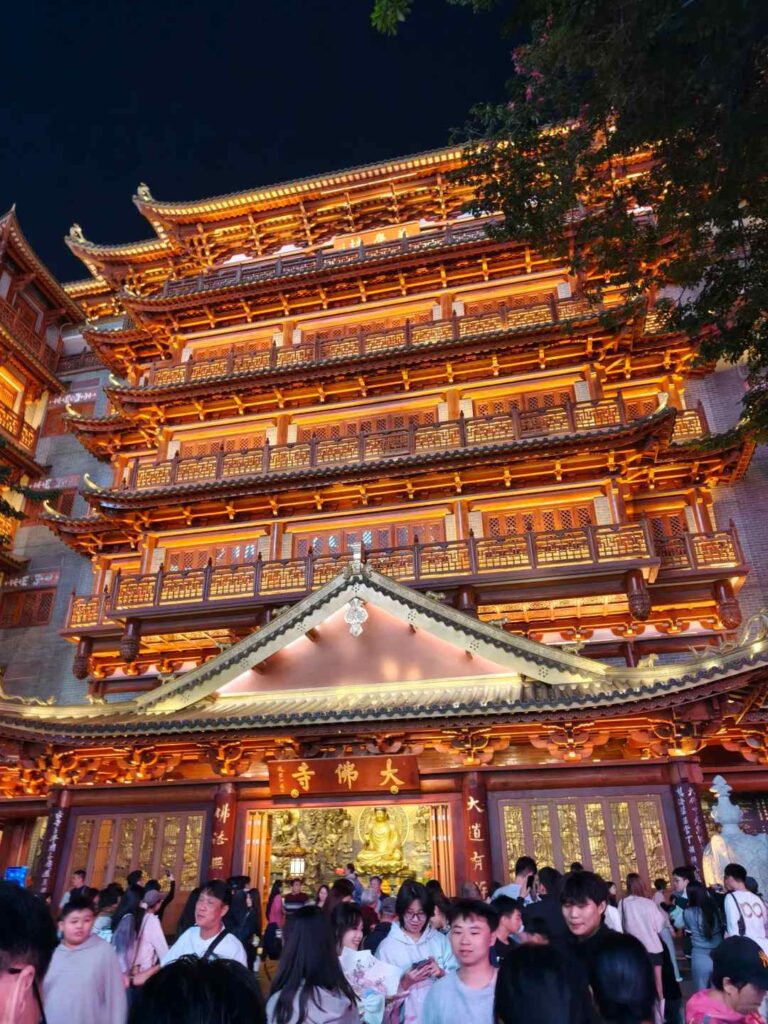
If you’re vegetarian, the buffet inside Dafo Temple is worth trying. It’s 109 yuan per person. Another good option is Fo You Yuan, just across from the temple. The vegetarian dishes there are nicely presented and taste good too.
Places to Visit Around Beijing Road
Beijing Road is in Guangzhou’s historic center, where you’ll find historic sites and narrow streets that have maintained the style of old Guangzhou. The area is a good place to see local life, and it’s easy to explore on foot. I’d suggest setting aside half a day if you want to take it slowly.
You can easily combine the places below with Beijing Road Pedestrian Street. They are all within about 1 kilometer, or 0.6 miles.
Yaozhou Site (药洲)
The Yaozhou Site preserves what is left of a royal garden from the Southern Han period, about a thousand years ago. Only a very small part of it survives today.
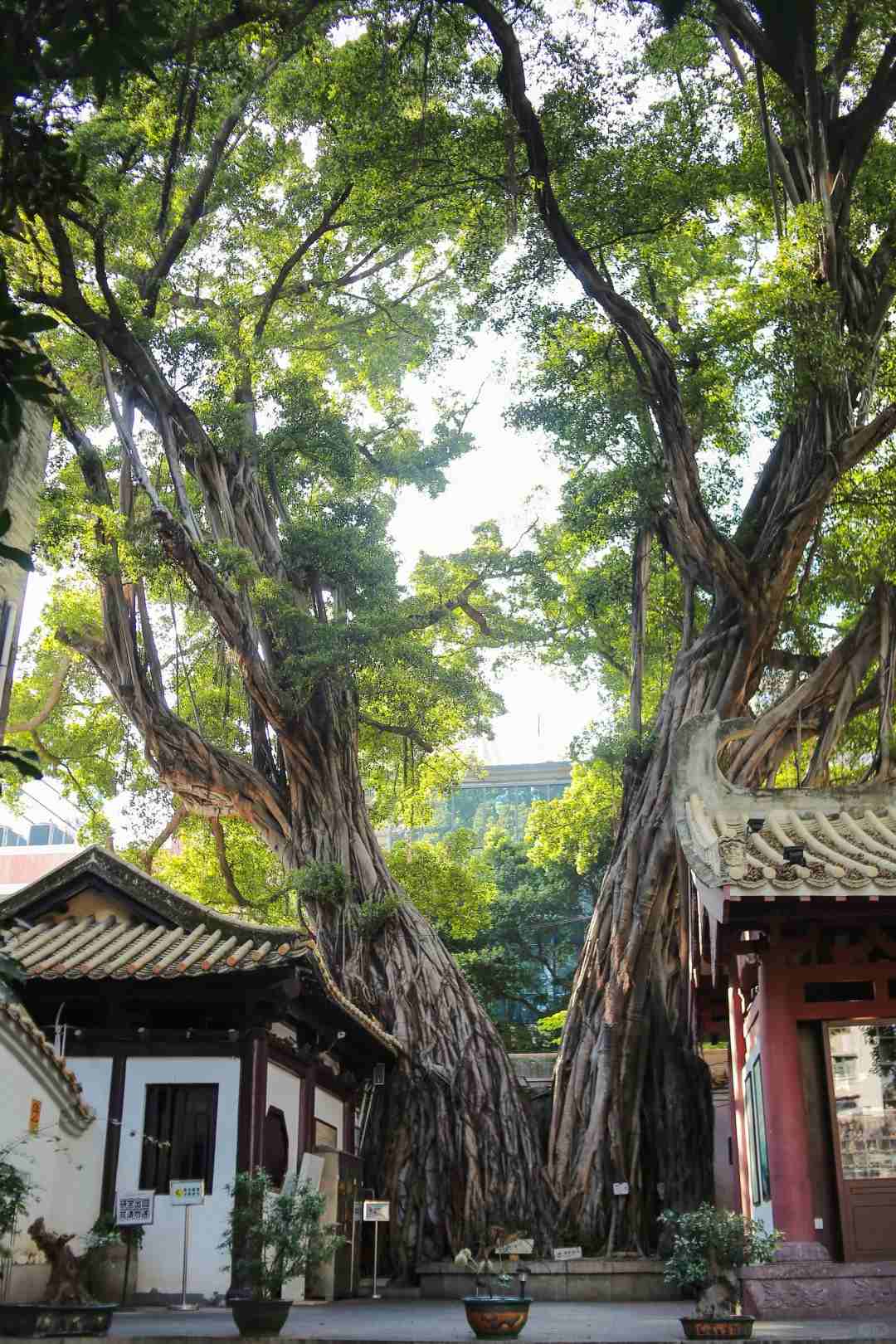
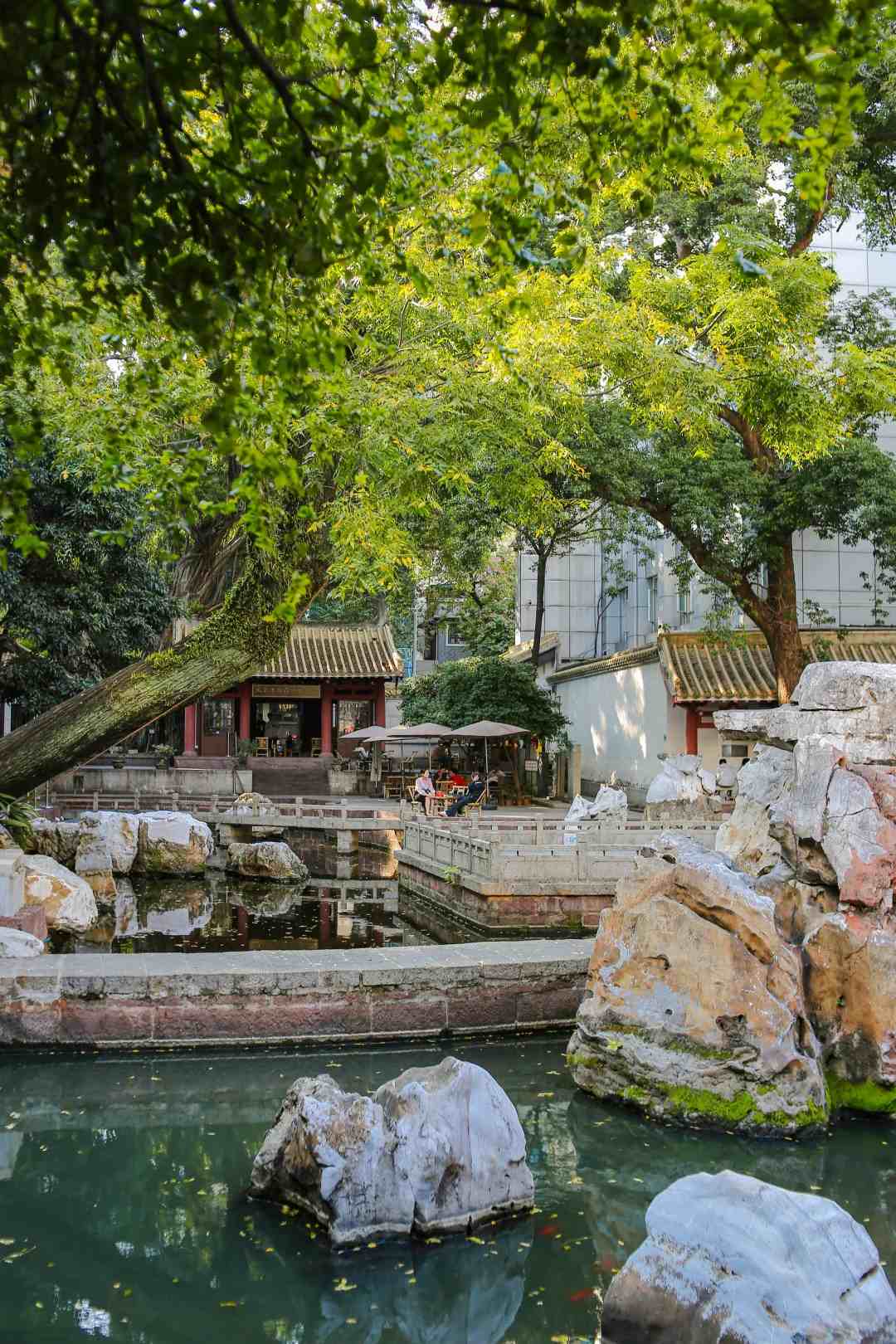
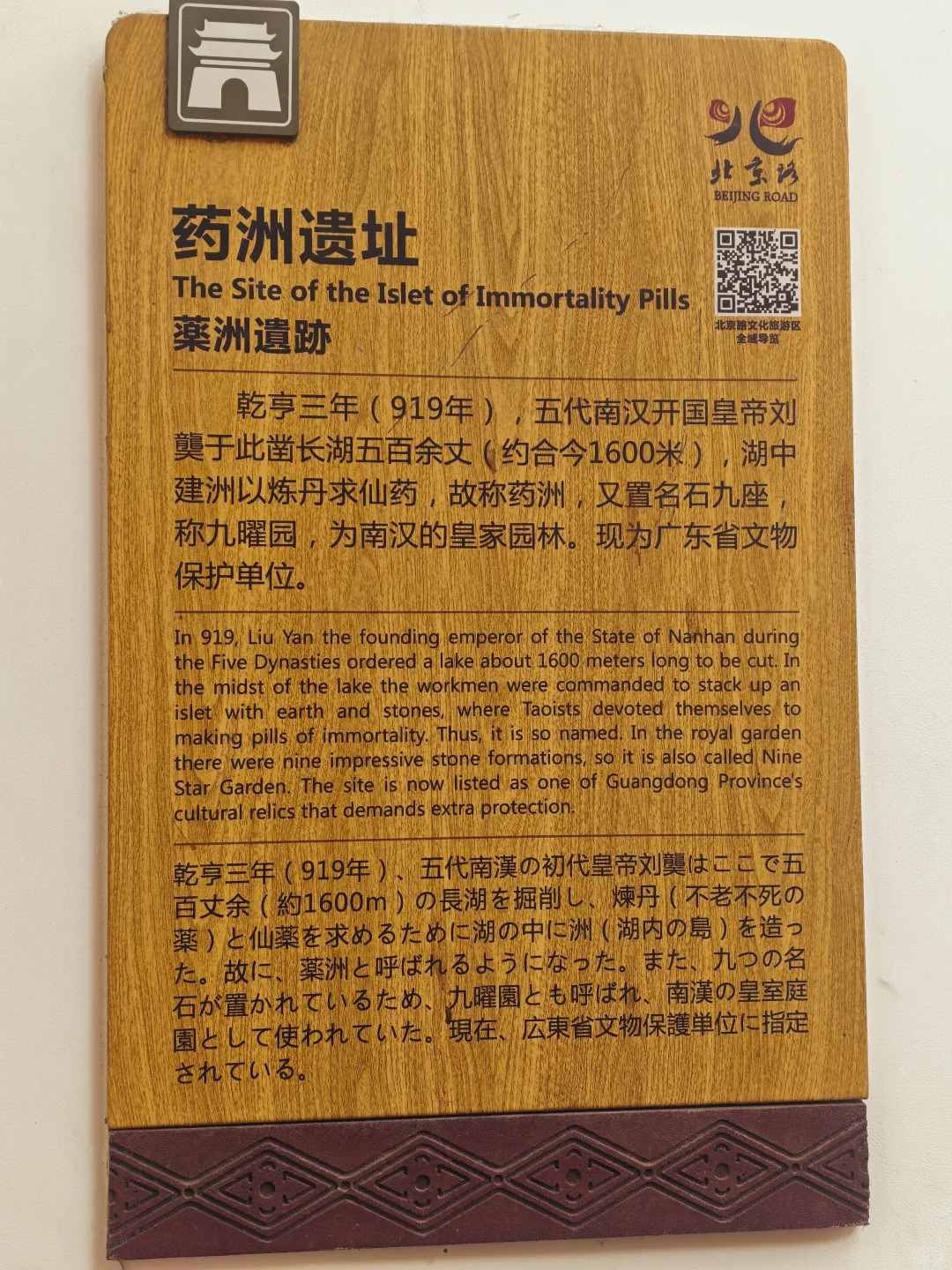
The main thing to see here is the Nine Yao Stones. They are said to be Taihu rocks brought by sea from Lake Tai in Jiangsu, about 1,000 kilometers (620 miles) away during the Southern Han period.
These nine rocks have unusual shapes and are carved with inscriptions dating from the Song Dynasty to the Qing Dynasty. The most famous inscription is the two characters “药洲” (Yaozhou) written by Mi Fu, the great calligrapher of the Northern Song Dynasty. There are also more than 90 other stone inscriptions here from several dynasties.

Nanyue King Palace Museum
The Nanyue King Palace Museum displays remains of the Nanyue royal palace from more than 2,000 years ago. The remains were discovered here in 1995, and it was named one of China’s Top Ten Archaeological Discoveries of that year. It’s one of the best places near Beijing Road to learn more about Guangzhou’s long history.
The site shows how Guangzhou has long been a political, economic, and cultural center in the Lingnan region. The main remains here come from two periods: the Nanyue Kingdom of the Western Han Dynasty and the Southern Han Kingdom of the Five Dynasties and Ten Kingdoms period.
One highlight inside the museum is the curved stone water channel. It is considered the earliest known royal garden site from the Qin and Han periods and is still relatively well preserved.
Another highlight is the stone-built pond, a large artificial pond from the Nanyue Palace royal garden. Its walls were built with stone slabs, and the bottom was paved with gravel and pebbles. You can also see palace ruins from the same period nearby.
The site’s archaeological layers are about five to six meters thick in total, and archaeologists have found remains from 13 historical periods here, from the Qin and Han dynasties to the Republican era.
Hundreds of wells have also been discovered here, dating from the Nanyue Kingdom to the Republican era. The wells show how the area was an important part of the city for more than two thousand years.
Admission: Free.
Hours: Tuesday to Sunday, 9:00 a.m.–5:30 p.m. Last entry is at 5:00 p.m. Closed on Mondays, except on public holidays.
Fuxue West Street
Fuxue West Street is lined with graffiti walls themed around Guangfu, or Cantonese, culture. They were created by the Wan Brothers, who are well-known 3D graffiti artists.
The murals are detailed and realistic, and since the street is close by, it is worth a quick stop.
Lingnan Finance Museum
The Lingnan Finance Museum is housed in a Qing Dynasty building that once served as Lujiang Academy.
The highlights here include the gold cakes unearthed from the Tomb of the Nanyue King. You can also trace the history of ancient coins and learn a little about Guangdong’s commercial history. There’s a fun interactive display where you can try lifting a stack representing one million yuan in cash to feel how heavy it would be.
If you have a full day, I’d also suggest adding nearby Yuexiu Park, Sun Yat-sen Memorial Hall, and the Museum of the Nanyue King Mausoleum to your route. They are about two to three kilometers (1.2 to 1.9 miles) from Beijing Road Pedestrian Street, so they are fairly easy to reach from there.
Food Recommendations on Beijing Road Pedestrian Street
Places I Tried Myself
Renxin Laopu Double-Skin Milk
I’d start with the desserts at Renxin Laopu.
My favorite was the double-skin milk with taro balls and red beans. The texture is somewhere between milk pudding, soft tofu pudding, and jelly. The red beans are soft and rich, and they give the dessert some texture.
The black sesame soup is also very good, and it’s made fresh to order. I like it because it’s warm and comforting, the way old-school Cantonese desserts often are. You can taste tiny bits of sesame, but it’s almost as easy to drink as a cup of tea.
Apo Heritage Beef Offal
At Apo Heritage Beef Offal, you get a small container filled with beef offal and other ingredients, including tripe, beef slices, beef tendon, beef intestine, beef balls, tofu skin, and radish.
The dish looks a little like Japanese oden, but the flavor is closer to a Chinese-style braise. There are enough different things inside that you’ll probably find at least one you like. Or, like me, you may enjoy the whole thing.
There is no seating here; it’s takeout only. But it’s very close to Dafo Temple, so I suggest taking it to the square in front of the temple, just a short walk away. There are plenty of open seats there, so it’s a good place to enjoy your beef-offal “oden.”
Chen Tianji Fish Skin Snacks
As you walk along Beijing Road, you can try some pretty unusual foods. The most unusual one for me was the fish skin from Chen Tianji. I rarely eat anything like it, which is part of why it stood out to me.
The fish skin feels a little rubbery when you bite into it, and it takes a while to chew even a small piece. Is it a main dish? Not really. Is it a peanut snack? Not exactly. The peanuts are served cold, and the flavor of the dish wasn’t very strong. For me, eating the fish skin is more about the experience than the taste, and something to try when getting to know a new city.
Yinji Rice Noodle Roll Restaurant
When you come to Guangzhou, you should definitely try rice noodle rolls. There are rice noodle roll shops all over the city, and Yinji is one of my favorites so far. It also has other locations around Guangzhou.
Their rice noodle rolls have thin, delicate wrappers and are generously filled. They’re fresh and satisfying, especially with a little soy sauce.
More Food Spots Near Beijing Road
Besides the places I tried myself, I also found a few other food spots with good reviews on Chinese social media. Think of this list as extra ideas rather than personal recommendations.
| Restaurant | What to Try / Notes |
|---|---|
| Jubao Roast Pigeon King | Roast pigeon with crisp skin and tender, juicy meat. Each dish is prepared to order. |
| Taiping Guan Western Restaurant | Giant soufflé, roast pigeon, and the “Premier Set Meal.” This historic restaurant has an old-school atmosphere. |
| Lianxiang Lou | Chicken biscuits, wife cakes, also called sweetheart cakes, and lotus seed paste mooncakes. This is a century-old Cantonese bakery. |
| Qiaomei Noodle House | Five-treasure wonton noodles with flavorful broth and smooth noodles. |
| Wentong Ice Room | “Sorrowful Rice,” lava French toast, and bear milk tea. |
| Feifei Fried Skewers | Fried skewers such as cabbage, fried tofu, and chicken wings. |
| Mihimihi French Flagship Store | Crispy cream sticks in original, chocolate, matcha, and other flavors. The appeal is the mix of warm pastry and cold cream. |
Guangzhou’s Three Popular Pedestrian Areas
Guangzhou has three well-known pedestrian areas. Besides Beijing Road, which this guide focuses on, the other two are Shangxiajiu Pedestrian Street and Yongqing Fang.
Compared with Beijing Road, Shangxiajiu is more focused on shopping specifically for clothes. Yongqing Fang is an old-town neighborhood with an artsier vibe.
Personally, I think Yongqing Fang and Beijing Road Pedestrian Street are enough for most visitors. Shangxiajiu doesn’t have as much character as the other two, and it feels less lively now than it did a few years ago.
If you’re short on time and can only choose one, I’d recommend Beijing Road Pedestrian Street. There’s more to see and do here, including unique things like Dafo Temple and the ancient road ruins. On top of that, there’s lots of Cantonese food nearby, so you can fit shopping, history, and food into one easy stop!


