Riding the Shanghai Metro: 7 Unique Stations
Many visitors come to China and leave impressed by how clean and on-time the subways are. And Shanghai is no exception. But what surprised me just as much was the station design, as each is uniquely built to reflect the history and personality of the neighborhoods it serves.
When I traveled around Shanghai, I took the metro everywhere. After enough rides, transfers, and “wait—where does this connect?” moments, a few stations stood out to me. There are five that I particularly enjoyed: the major hub at Shanghai Railway Station, the butterfly wall at Hanzhong Road Station, the classic style of Huaihai Middle Road, the five-line transfer center at Longyang Road, and the black-and-white contrast at Danyang Road. I’ve described them below, and also included Wujiaochang (personal for me) and Dabaishu, which has become a popular photo spot.
As of 2026, Shanghai’s metro system has 21 lines, 523 stations, and about 906 kilometers (563 miles) of track—making it one of the largest urban rail systems in the world. Daily ridership can reach over 10 million.
1) Shanghai Railway Station Hub
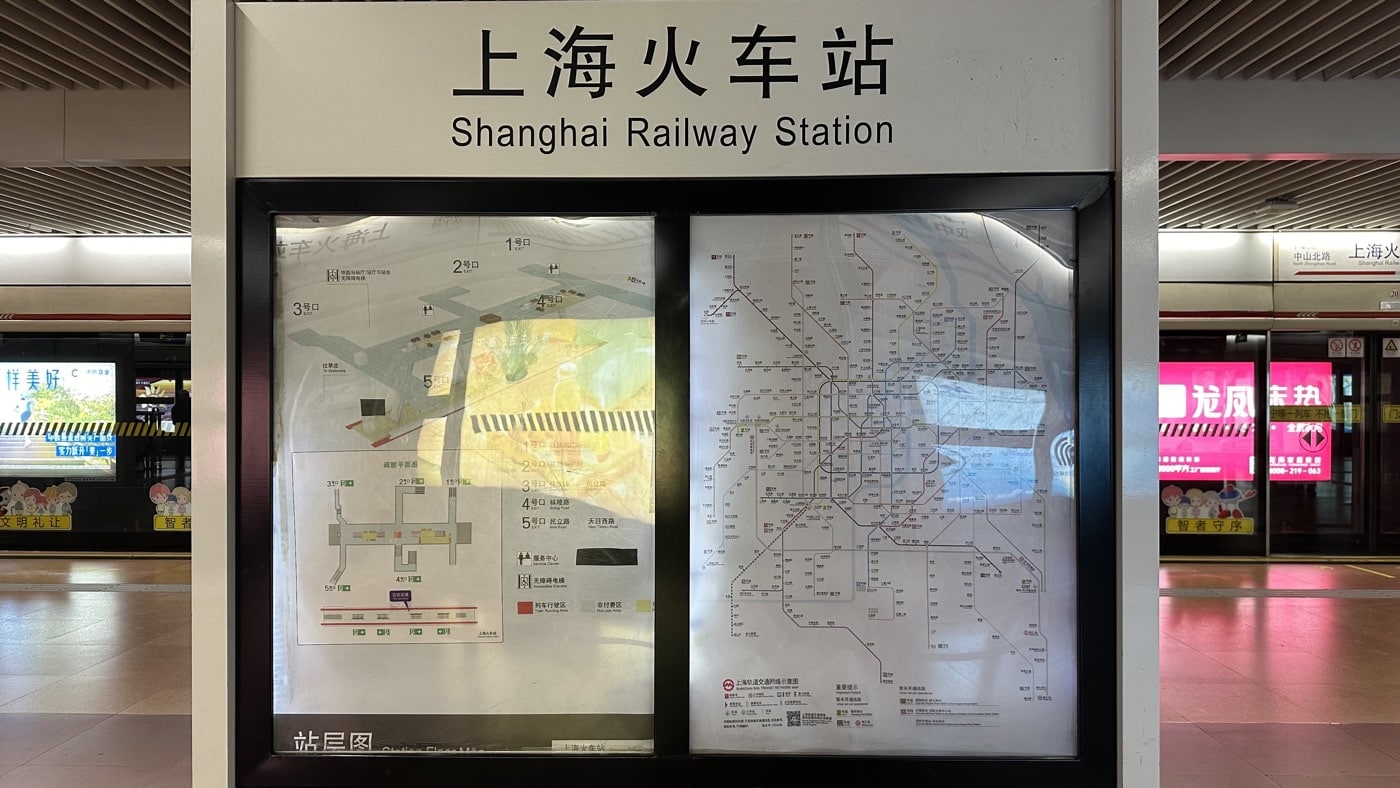
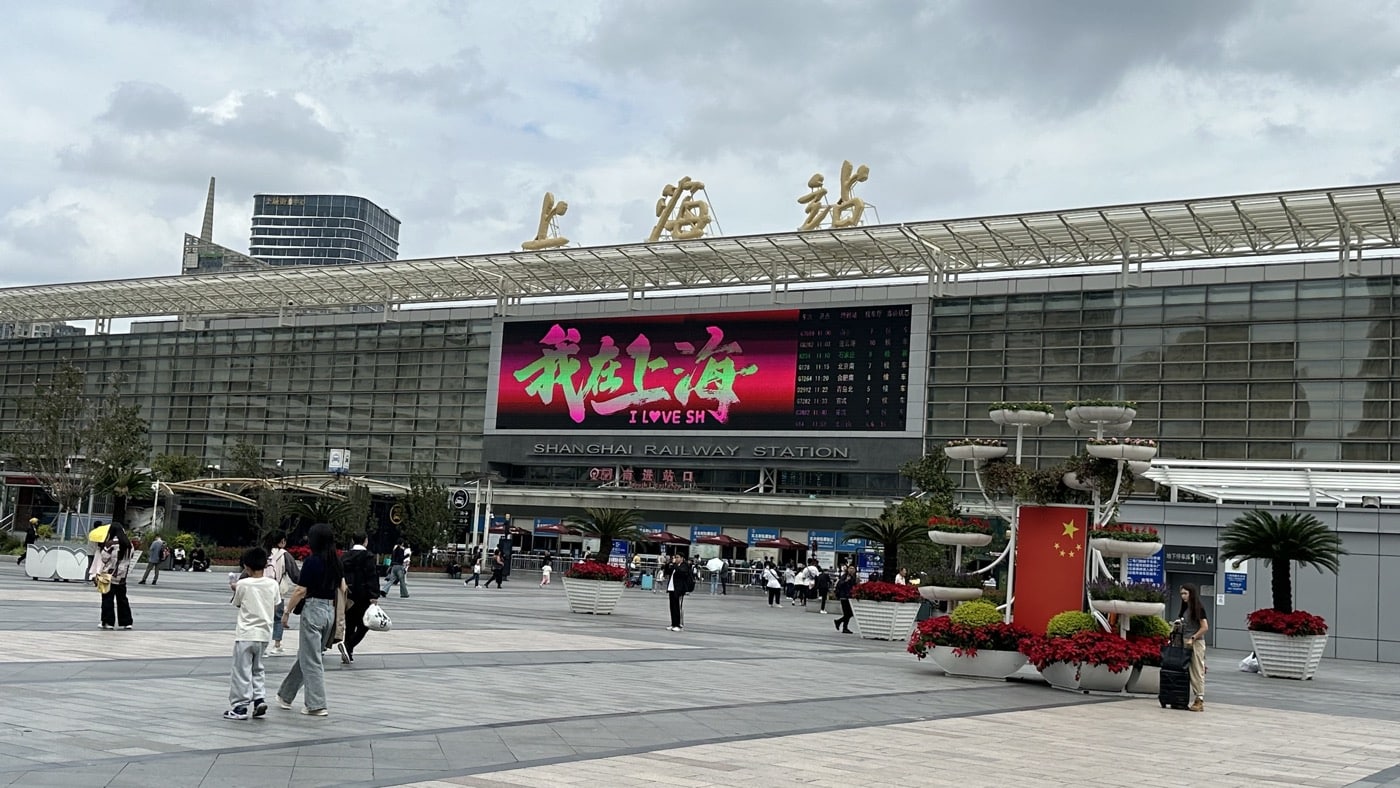
Shanghai Railway Station is one of the city’s classic arrival points. Before high-speed rail and the metro network became what they are now, many people entered Shanghai by train. Over time, this area turned into a major hub, linking conventional rail, the metro, and high-speed rail all in one place. For many first-time visitors, the first thing they notice when they arrive is the huge characters on the sign: 上海站.

2) Butterfly Wall at Hanzhong Road Station
Hanzhong Road Station is the very next stop after Shanghai Railway Station, and it’s a convenient transfer point for Lines 12 and 13. If you arrive the way I often do, by high-speed rail into Shanghai Railway Station, switching lines at Hanzhong Road is easy to figure out. From here, you can branch out in a lot of directions across the city, like hopping on Line 13 toward places around Xintiandi and the Tianzifang area.

I came here specifically to see the butterfly theme, which is often described as one of Shanghai’s prettiest metro station designs. In the transfer corridor between Line 1 and Line 12, you’ll spot the butterfly wall right away. Under shifting lights, the butterflies in the display seem to change color, and when the lighting runs in sequence, it looks like they’re fluttering.
In some photos and posts online, you’ll see nearby columns lit up with a neon butterfly effect too. When I visited, those lights weren’t on (maybe it depends on timing or maintenance) so keep this in mind if you’re going to this station specifically to see the butterflies.
3) Old Shanghai at Huaihai Middle Road Station
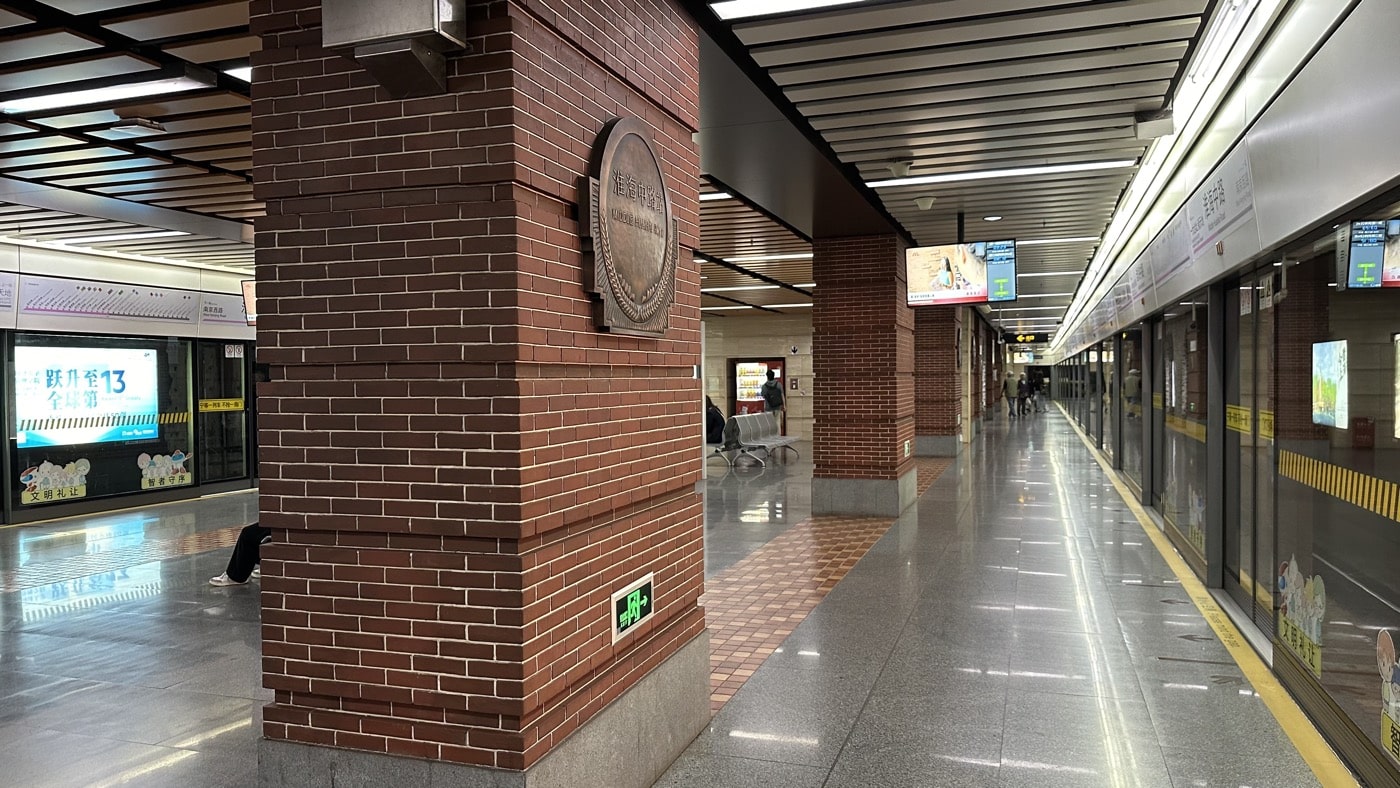
Shanghai has been a busy and glamorous metropolis since the early Republican Era in China, and one of the signature designs from that time is brick and deep red walls. If you want a taste of this classic style inside the metro system, Huaihai Middle Road Station is worth a stop.
Right as the train pulls in, you can see the red columns and brickwork running along the base of the platform. This station has a more vintage style than many of the others, and it showcases the history of architectural style in Shanghai. The trademark detail is the signage: a weathered bronze plaque that represents the world people associate with “Ye Lai Xiang,” a famous Shanghai folk song from the 1940s that evokes feelings of nostalgia for old Shanghai, often seen as a symbol of the city’s romantic past.

4) The Five-Service Transfer at Longyang Road
If there’s one station that shows off the Shanghai Metro’s sheer scale, it’s Longyang Road. If you’ve ever visited Shanghai for work or connected through Pudong, there’s a good chance you’ve passed through it. It’s the most common gateway to Pudong, and also where you can switch to the Maglev, which is a highlight for many tourists and also a quicker way to get to the airport.
Longyang Road connects almost everything, with transfers between four metro lines and connections to the Maglev, which is why it’s known as a five-way interchange. All of these convergences mean that this station can take you to most places in the city, which is what makes it so notable within the metro system overall.
Line 16 is useful for getting to Shanghai Wild Animal Park or heading down to Dishui Lake at the city’s far southeast edge. But I personally love that it also runs different service patterns, including regular trains, limited-stop trains, and express-style options. This flexibility is evidence of how quickly Shanghai’s rail system continues to evolve.
Many of the Shanghai stations have turned transfer corridors into mini art and culture exhibits, including Longyang Road. In the main passageway there’s a big “train wall,” covered with photos that trace the metro’s story from early planning decades ago through major milestones as the network expanded.
Tucked off to the side is a massive painting, roughly 14 meters by 4 meters, referencing Málaga—Picasso’s hometown. 20th-century art in a busy metro station may seem out of place, but Picasso is known for breaking forms apart and reassembling them, which is what this station is for Shanghai: different lines crossing, overlapping, and stitching the city together in one place.


5) Black-and-White Contrast: Danyang Road Station
If you look back at Shanghai’s history over the past century, there are two distinct periods: the earlier, classic years and the more recent decades of rapid acceleration, during which the economy, technology, and architecture changed dramatically. Danyang Road Station captures this contrast by splitting the station into two design halves, with black on one side and white on the other. It’s simple but effective.
When you ride the escalator up from the platform to the concourse, the black-and-white split continues. On one side, you’ll see framed black-and-white photos that nod to Yangpu’s early industrial history, including late-19th-century sites like the Yangshupu Waterworks (1883), along with old factories and power plants. On the other side, the white wall is filled with electronic screens. The content itself isn’t necessarily the point, but rather an attempt to make you think of the city as it is today, modern and tech-driven.
When you recognize the “then vs. now” concept, the design feels more intentional and tells a unique story.


6) A Station Full of Personal Memories: Wujiaochang
If judging purely by design, Wujiaochang Station isn’t necessarily a standout, and it usually doesn’t show up on the “most unique metro stations” lists. But when you spend enough time in a city, at least one station starts to feel personal amongst the hundreds spread across Shanghai. For me, that station is Wujiaochang. Not unlike the black-and-white theme at Danyang Road, my memories here don’t disappear, even if the details get a little blurry over time.
To picture Wujiaochang, think of a busy neighborhood with a cluster of big malls within walking distance from the station. If you leave Wujiaochang and walk a bit, you’ll see a huge egg-shaped building, which is one of the area’s most recognizable features. Locals like to give it their own fun nicknames, and once you see it, you can come up with your own.
Around that landmark there are underground walkways leading in different directions, connecting to malls like Wanda Plaza, Bailian Youyicheng, and Parkson. The area stays busy, but it’s not a major tourist stop, so it’s a popular area for locals to shop, hang out, catch a movie, and just enjoy everyday life.


When I visited, it was close to lunchtime, so I grabbed a Pizza Hut pizza and picked up a small toy as a souvenir for my daughter.
7) Autumn Vibes: Dabaishu Station
A subway station doesn’t have to be architecturally fancy or near a famous attraction to be special. Sometimes all it takes is the simplest kind of beauty—nature—to draw people in.
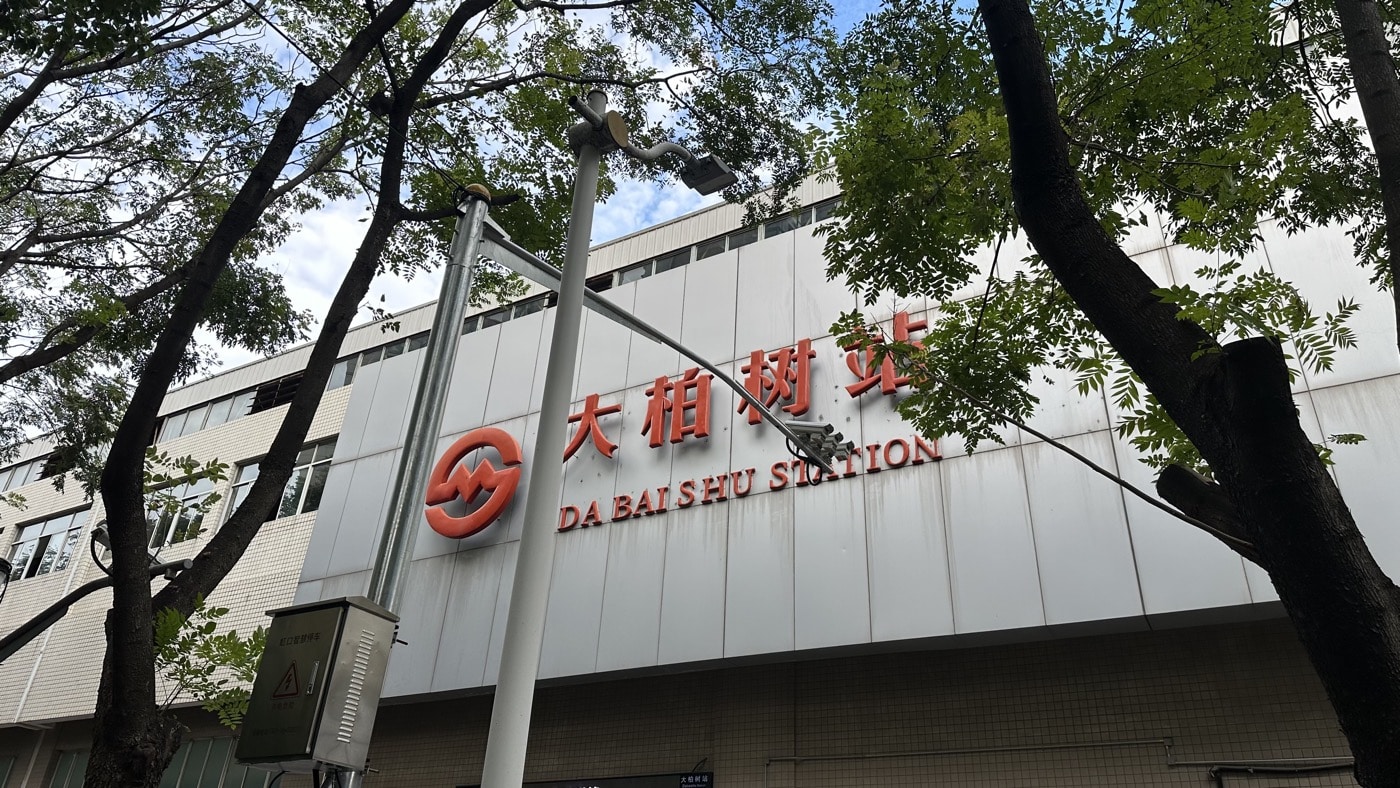
Dabaishu Station sits in a part of Shanghai more removed from the city center and popular spots like the Oriental Pearl Tower. From the outside, it’s like many of the older stations, with everyday walkways nearby and locals coming in and out. Once you’re on the platform, though, you can see the industrial designs, including arched steel beams and big ceiling fans like you’d see in old factories.
The surprise of this station is when you look out the windows to the side, where there’s a view of trees and lush greenery. The long glass wall frames the natural landscape like a painting, especially in autumn as the colors change. The station feels like it’s right in nature, so the atmosphere is calmer than some of the others. Plenty of people pass through here to ride the train, but many come specifically to take photos of the scenery.


More Shanghai Metro Moments
As I said at the beginning, Shanghai’s metro system now has 20+ lines and 500+ stations. The seven stations I shared here are simply the ones that stayed with me, but there are plenty more with their own character, and you could never fit them all into one piece.
And everyone’s taste is different. What I love might not be your favorite at all. That’s part of the fun: Shanghai’s huge metro network has so much to discover, and the best way to find it is to go explore for yourself.
Read More:
Where to stay in shanghai
Is Shanghai Safe for Tourists?
Best Things to Do in Shanghai